
.jpeg)


We are delighted to announce our investment in Wavelength, a first-of-its-kind, AI-native dating experience. In our view, online dating is not an era gone by. On the contrary, it is a $10B+ global category with unrealised market potential. Before we go into why we backed Wavelength, here is our view of how the category has shifted shape over the past few years.
Matchmaking Is Evolving
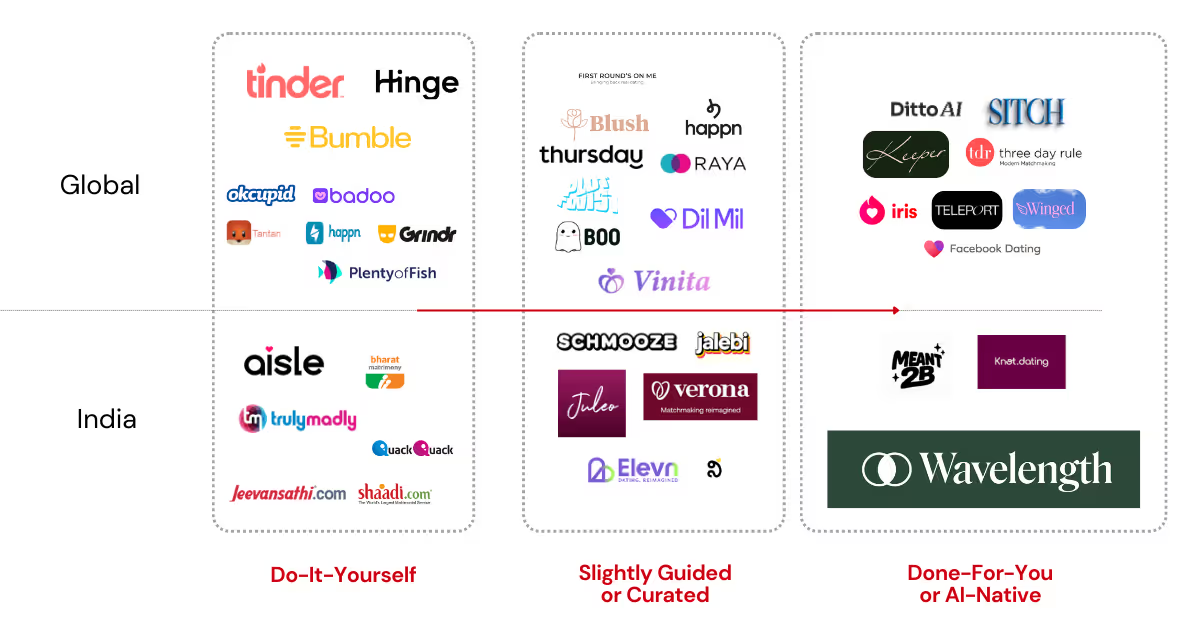
The first wave was self-serve swipe apps, built for scale and discovery.
The next wave introduced curated dating, adding trust, identity, and intent through verification, culture, or community.
Now, a third wave is emerging: AI-native matchmaking, where systems take on the work of filtering and matching, not users.
To illustrate this evolution, we mapped the global matchmaking landscape across these stages.
State of the (Un)Union
Today, dating apps put the onus on users to find the right partner from what the algorithm serves. The result is growing fatigue. The binary-swipe dating market, once considered unstoppable, is now showing clear signs of saturation. The stock prices of Bumble and Match Group which together operate over 45 dating products including Tinder, Hinge, and OkCupid have fallen nearly 90% and 68% respectively over the past five years, erasing more than $40B in market value since 2021. Most notably, incumbents have scaled back in India owing to user dissatisfaction, highlighting a massive whitespace in the region.
There is also a growing need for intentional curation. Seven out of ten online daters encounter people lying on their profiles. Sixty-six percent of women aged 18–49 report being harassed, and 56% report receiving sexually explicit images they didn’t ask for.
This growing disillusionment is creating room for something new. The future of matchmaking will belong to products that truly deliver on curation
Enter AI-Native Matchmaking
A new category of apps is emerging. Here, you don’t swipe, you converse with an emotionally intelligent agent that learns your preferences, filters, and constraints, and does the work of finding, vetting, and setting up introductions that reflect who you are.
This is a market-expansion technology in what is today a ~$10B revenue pool. Traditional dating apps succeed 9–11% of the time; professional matchmaking achieves 70–80%. AI can bridge this gap, delivering the intimacy of a $100,000 concierge service at massive scale.
Why India Is Uniquely Primed for This Category
- It is one of the few categories where users already pay for outcomes, not engagement. Matchmaking has always been a trusted, paid service. Matrimony.com generates ~₹500 Cr in annual revenue.
India’s relationship economy is trust- and intent-led. With one of the lowest divorce rates globally, low female workforce participation, and fewer organic meeting spaces, digital matchmaking fills a structural gap. - This category defies the “low ARPU” narrative. Trust, privacy, and relevance are premium currencies, and personalisation drives willingness to pay.
Why Wavelength

Wavelength is led by Ishaan (IIT Delhi, ex-Frontrow, Stable Money), Vinit (ex-Bluelearn), and Jayanth (technical co-founder, previously dabbled with Voice AI). The team brings strong product taste, GTM execution, and cultural intuition for India’s Gen Z, paired with deep obsession around fixing what’s broken in dating.
Dating today is built around effort and noise. Users answer impersonal questions, upload a handful of photos, swipe endlessly, juggle dozens of conversations, and are left to plan everything themselves. Wavelength flips that model on every single step of the customer journey:
(1) Onboarding: Instead of filling out a list of prompts, users start by talking. Onboarding begins as a natural conversation with Wave, an AI wingwoman that learns preferences, non-negotiables, and intent the way a close friend would.
(2) Exploring: Instead of swiping through thousands of profiles, users receive a small, highly curated set of recommendations. Wave does the work: filtering, refining, and iterating until there is genuine interest.
(3) Matching: Instead of juggling chats inside a noisy app, Wavelength moves connections to email, where conversations feel more intentional and less performative. This choice is grounded in deep user research, not convention.
(4) Meeting: Instead of leaving logistics to chance, Wavelength sets up the date end-to-end, partnering with some of Bangalore’s hardest-to-get-into restaurants to create a memorable first experience.

What emerges is not a better dating app, but a fundamentally different experience: outcome-first, low-effort, and deeply personal. With early traction, a clear path to network effects, and the potential for a powerful data moat, Wavelength has the ingredients to build a differentiated, global-ready matchmaking product in one of the largest yet least-innovated consumer categories.
What Wavelength Truly Is
Matchmaking is just the wedge. The deeper opportunity is an AI OS for human connection. The true moat lies in trust and rich contextual understanding of individuals. Once compatibility can be simulated, the application extends beyond dating to friendships, networks, and communities.
Why Us
We met the team when Wavelength was a plan on a Notion page. Through Antler’s AI Residency, they sharpened their vision, tested prototypes, and built conviction around the problem. We’re excited to back them as they build not just a better dating app, but a new paradigm for how people meet and connect in the AI era.
Wavelength is taking you on a date this Christmas!
This Christmas, Wavelength is taking 100 couples on a date in one of Bangalore's hardest-to-get-into restaurants. They promise to own the entire experience from: matching you with someone you’re most likely to be on the right wavelength with, getting the conversation started (no ghosting) and setting up a magical offline date.
Sign up here: https://www.heywavelength.com/
For updates on the exciting stuff they’re building: https://x.com/vinitsarode_
ANTLER RESIDENCY —LAUNCH YOUR STARTUP
Antler backs exceptional founders to go further, faster.

.jpg)
%20(1).jpg)
