-3.png)


Most of what gets written about women founders follows a familiar script: the funding gap, the 2% statistic, the call for more capital. The data matters, and we have written about it ourselves. But data alone doesn't capture what it actually feels like to build a company as a woman, the doubt, the trade-offs, the moments when they almost didn't start.
So we asked two founders in our portfolio to tell us what the journey has really been like.
Tia, co-founder of Enaxiom, is building deep-tech hardware to make AI infrastructure sustainable. Jo Thomas, co-founder of Enrola, pivoted from a failed first idea into a company that's now gaining real traction. Their paths look nothing alike. But the thread that connects them is the same: they started before they were ready, and they built through the doubt.
Starting in the Deep End
Tia didn't choose an easy problem. Enaxiom operates in a space with no local playbook: climate hardware, long development cycles, and capital intensity that keep most founders away.
"Hardware is hard," she says. "You can't just ship an update overnight. You're dealing with physics, manufacturing, and supply chains. And we were building with just the two of us."
Without a ready-made network of climate hardware founders to lean on, Tia had to build her own support system from scratch, seeking out mentors, engineers, and operators who had scaled similar companies. "In hardware, you have to learn fast and build right the first time."
What kept her going was the urgency of the problem. "The energy and water impact of AI infrastructure is growing rapidly. Knowing the problem is real and urgent has always outweighed the difficulty."

Jo's start was different, but no less difficult. Her original business idea failed. No product-market fit, no tailwind, and the weight of having spent investor capital on something that wasn't going to work. This forced pivot became a crucible, an essential, though painful, lesson that would define the approach to her next endeavour.
"Having the courage to let go of something you've poured yourself into is brutal," she says. "Especially when you've spent other people's money."
It was her co-founder, Yvette, who helped her see what could come next. Together, they pivoted to Enrola, a company that builds AI agents that help outbound sales teams contact and convert more leads, and the lessons from that painful first chapter became the foundation for everything that followed.
Building Confidence Through Doubt
Neither founder pretends that self-doubt is something you conquer once and move past. For both, it's a constant companion, one they have learned to work alongside rather than wait to overcome.
For Tia, the doubt wasn't about the mission. It was about whether she could be both the founder and the mother she wanted to be.
"My daughters were one of the biggest reasons I started this company. I wanted to work on something that would positively shape their future. But there was a paradox: I was building something for their future while working long hours in the present."
The shift came when she stopped hoping for balance and started structuring it. "When I'm with them, I'm present. When I'm working, I'm fully working." Over time, her perspective changed, too. "I realised that by building this company, I'm modelling something. They're watching me build, fundraise, make hard decisions, and back myself. They're seeing that women can lead in deep tech."
Jo's relationship with doubt is more blunt. "It doesn't really go away. You just get better at functioning with it in the background," she says.
There's no mindset hack behind it. Just persistence. "I just keep pushing forward. Not because I've figured something out, but because stopping isn't really an option I'm wired for. The more you build the reps, the more confidence you have."
Two Different Experiences of the Same System
This is where most articles about women founders and fundraising tell you the same story: globally, all-female founding teams still receive around 2-3% of venture capital.
But what is less often shown is how differently individual founders experience that same system, and how both experiences can be true at once. Tia noticed it in the questions she was asked. "Early on, I didn't think gender would play a role in fundraising. I believed that if you had a strong business, the capital would follow."
Over time, she recognised a pattern well-documented in research: female founders tend to receive more risk-mitigation questions, while male founders are asked about growth and upside.
"The questions weren't hostile. But they were different, more focused on the downside." Her response was strategic: answer the risk first, explain how it's been engineered out, then pivot to the scale of the opportunity.
Jo's experience was different. "Honestly? I raised, and I didn't experience anything that felt gendered. But I also don't know what the experience would have been if I were a man."
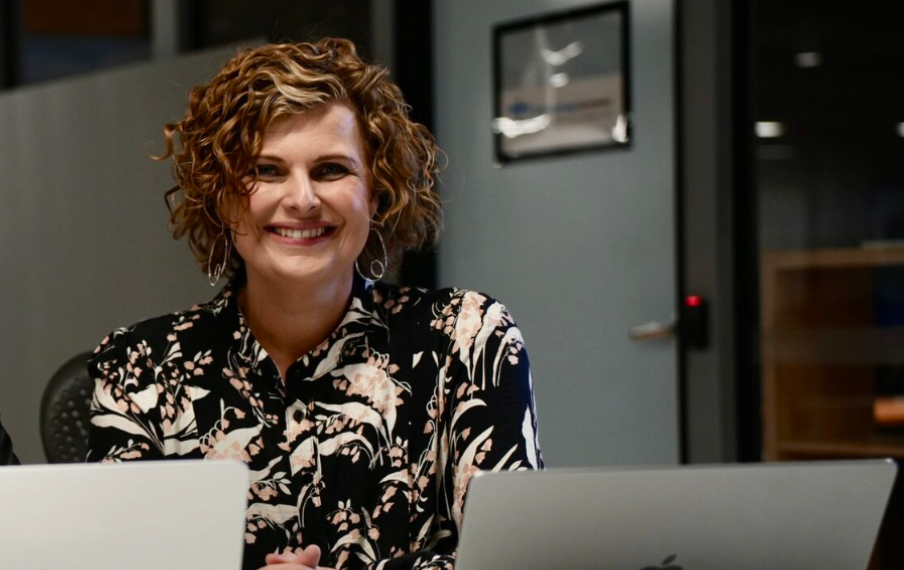
Both perspectives matter. Tia reveals the structural patterns that persist. Jo's is a reminder that individual experiences vary, but the systemic picture remains clear. Holding both truths at the same time is more honest than pretending either one tells the full story.
Why Early Support Changes the Trajectory
Both founders point to Antler as a turning point, not just for capital, but for the structure and community that helped them move from ambition to execution.
For Tia, Antler was the catalyst for Enaxiom's existence. "I knew I wanted to build again. I knew I wanted to work in hardware and climate tech. But I didn't have the idea yet, and I certainly didn't have the co-founder." She and her co-founder, Bijan, come from completely different worlds. "There's no way we would have crossed paths without the residency program."
For Jo, the program reframed what early-stage building actually looks like. "Antler helped me understand that 0-1 is a completely different game to 1-100. That meant I didn't waste months designing logos and workshopping strategy when I should have been building and talking to customers."
What both stories underscore is that early support extends well beyond capital. It's about the right environment: co-founders, mentors, networks, and the conviction to back founders before the market does.
What Still Needs to Change
When asked what real progress looks like, both founders push past surface-level answers.
Tia focuses on the pipeline. "If capital doesn't flow early, the pipeline never matures. We can't point to a lack of unicorns if we're not giving women the same starting runway." She also calls for greater transparency: if investors tracked and reported why they pass on deals, they might start to see whether women are disproportionately filtered out for perceived risk.
Jo zooms out further. "The problem starts well before anyone walks into a pitch meeting. Women are overrepresented in lower-paid, service-oriented roles. That shapes what kinds of businesses they want to build, and those businesses often don't fit the VC model."
She adds a practical reality that's often glossed over in funding reports. "Women still carry most of the load at home and with kids. You have to wonder when they're meant to find the time to do a startup."
Her conclusion is direct. "More funding programs are great, but the real shifts need to happen way upstream. Childcare, pay equity, and how we value different kinds of work. That's the stuff that actually moves the needle."
You Will Never Feel Ready
Perhaps the strongest thread across both stories is the advice they would give to women considering starting a company.
Tia's message is clear: "You will never feel ready. There isn't a moment when you suddenly feel fully qualified, fully confident, fully resourced. Especially as women, we tend to wait until we've de-risked the idea, while many others just start."
Her advice: "Start before you feel ready. Test the idea. Have conversations. Put something into the world. Don't mistake self-doubt for incapability. They're not the same thing."
Jo puts it in her own way: "Readiness is what people pretend they had afterwards, once they've survived it. Most of my best moves started with mild panic and saying yes anyway."
She offers her own track record as proof. "I said yes to a job at a scaleup that had spelling mistakes in the ad. That company turned out to be one of Australia's first unicorns, and I ended up ringing the ASX bell with the executive team when we IPO'd. I said yes when a chairman offered me the CEO job and then immediately threatened to fire me in the same breath. I said yes to starting Enrola with no guarantees it would work. None of it was a master plan."
Her closing words are worth sitting with:
"You are ready. You've already proven you can do hard things. So say yes, back yourself, and build the wings while you're flying."
ANTLER RESIDENCY —LAUNCH YOUR STARTUP
Antler backs exceptional founders to go further, faster.