
-5-2.jpg)


Every company has spent years deciding who can access what. There are passwords, permission levels, and entire teams built around the question of who is allowed to do what inside their software. The answer to "who did that?" has always been findable.
Then AI agents arrived.
Today, companies are giving AI tools the ability to search their records, send emails, update systems, and take actions inside the software that runs their business. These agents are doing real work, on real data, inside systems that were never designed to receive them. The access is real. The actions are real. But the rules governing what an AI agent is actually allowed to do, and the record of what it did, barely exist.
Matt Doughty saw this gap opening up. Not because he works in AI research, but because he spent ten years watching the human version of it never quite get resolved.
A Problem He Watched Build for a Decade
Matt arrived in Australia in 2018 with a background in post-sales and technology. His most recent role before starting Prefactor was at Procore, where he built the customer success function for the entire Asia-Pacific region. That meant years inside large software organisations, watching what happens after a sale closes: the slow, complicated reality of getting people the right level of access, keeping track of who can see what, and cleaning it all up when someone leaves.
"Essentially, what we were doing is unifying the logging in and the permissions and the audit side of what you do for a software platform," he says. "So your login is who you are, the permissions is what you can do, and then the audit is being able to track everything."
It sounds simple. In practice, most companies handle each of those three things differently, in different places, with different levels of care. The result is a sprawling, fragmented mess that is hard to manage and harder to clean up.
For people, this is a well-known problem. Companies have built entire product categories to manage it. For AI agents, nothing equivalent exists yet. And the agents are already inside the systems.
Where Prefactor Began
Matt joined the Antler Australia Residency in August 2024, knowing the domain he wanted to build in, but not yet knowing exactly what the company would be. He cycled through ideas, roughly five of them, testing directions against the problem he had spent a decade watching go unsolved. One early co-founder match fell apart two weeks in. He kept going, upskilling rapidly and running conversations to find the shape of the thing.
Those conversations became the foundation. Before leaving the residency, Matt had completed over 150 calls across a hundred companies, talking to the senior technical and business leaders who would first feel the access and oversight problem in their AI stack. Getting those conversations required a specific kind of credibility. Cold outreach alone rarely opens doors at that level. Antler was a key part of the answer.
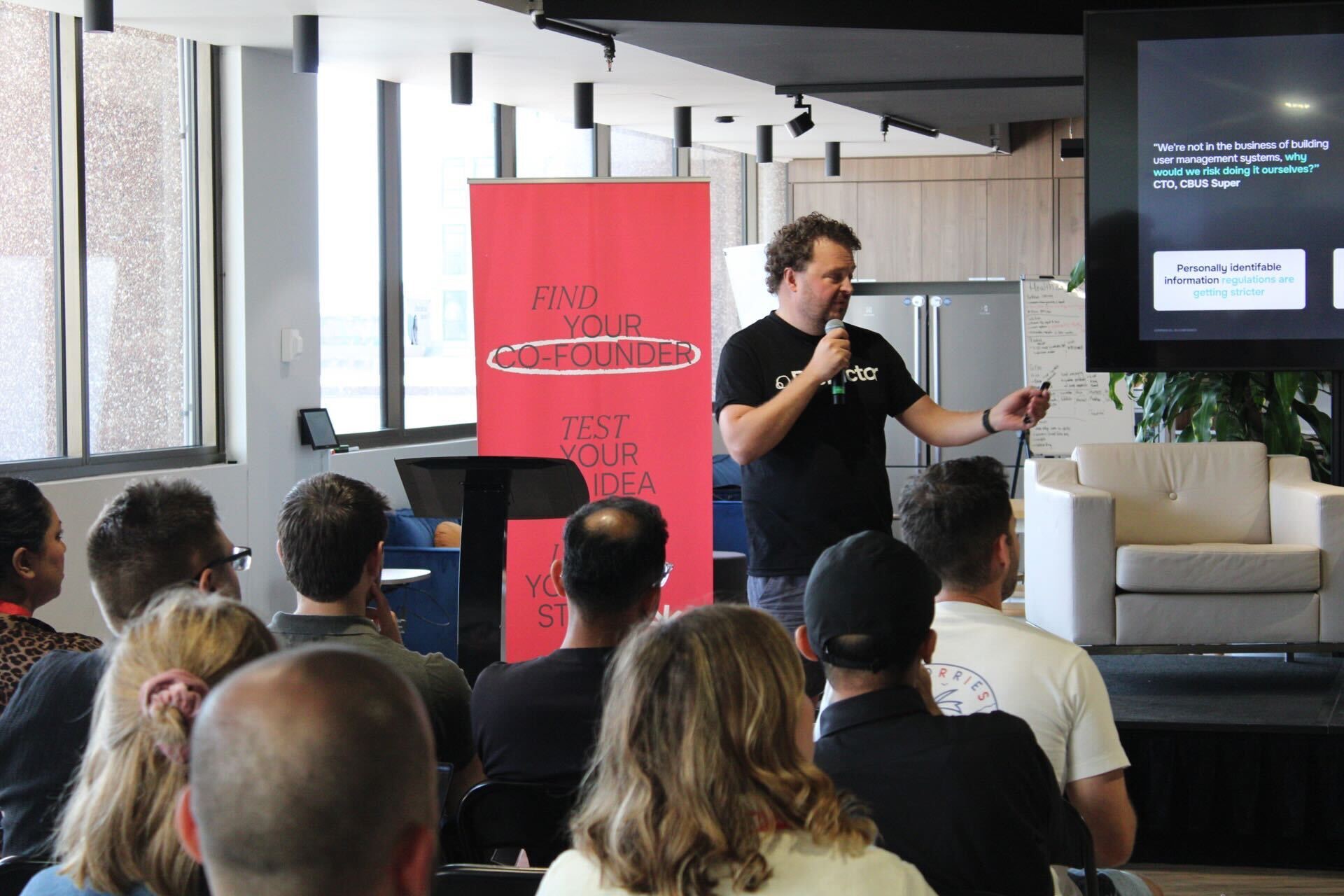
"The credibility part, I leveraged Antler and was like, 'I'm in the Antler Residency, we're looking to research this from some of the top kind of voices in the space,'" Matt says. "Give yourself a bit of credibility and then focus on something a bit broader."
In the conversations themselves, his approach was simple. He listened far more than he talked. "You do that through genuinely listening for 80 to 90% of those calls, not talking too much, asking big open questions," he says. "In my head, I know exactly what I'm doing, and I know exactly the questions I'm asking. I know exactly the outcome I'm trying to get."
By the end of November 2024, Antler backed Prefactor on its original authentication and access management direction. The 150 conversations had confirmed the problem was real. What they hadn't yet revealed was how the market would shift, and how many times Matt would need to move with it.
A Hypothesis Worth Testing
In June 2025, Matt made his first pivot. A new standard had been gaining rapid traction across the AI industry: a protocol that defined how AI tools could connect directly to external software and take actions inside it. Rather than every AI product building its own custom connections, this standard would act as a universal bridge between an AI and any application it needed to use. For example, an agent with access to your CRM could search records, send emails, or update data, all triggered by a single instruction.
"MCP is the translation layer between an AI and either a database or software platform," Matt explains. "So it very simply allows you to use Claude or ChatGPT, for example, to communicate with your favourite applications."
The hypothesis was clear. As software companies opened their platforms to AI agents, they would need a secure, governed way to expose those connections to their own customers. Prefactor would be the access layer that made it safe. It was a real problem. The timing looked right. Matt raised a pre-seed round in September 2025 on the back of that direction and took it to market.
What the Market Actually Said
The customer-facing MCP hypothesis did not hold. The model providers had not built a good enough end-user experience to support it. The standard itself was moving so fast that enterprises could not justify building on top of it. The problem was real, but the point of pain was not where Matt had expected to find it.
What enterprises were actually doing was investing heavily in internal AI agents and MCP infrastructure. They were building agents to run operations, automate decisions, and work inside sensitive systems. And the challenge that kept surfacing was about governing the agents already running inside the business.
In November 2025, Matt attended Antler's Embark event in San Francisco. The event brought together investors, founders, and enterprise buyers, and the conversations crystallised what the market had been pointing toward. The opportunity was bigger than what Prefactor had been building toward, and different in shape.
Prefactor pivoted for the second time. This one was the one that mattered.
What Prefactor Actually Does
The product that came out of that second pivot is a performance management platform for enterprise AI agents, what Prefactor calls an Agentic Operational Layer.
The problem Prefactor is solving has a number: 95% of enterprise AI agent deployments never make it from proof of concept to production. The barrier is rarely technical capability. It is operational readiness, the ability to govern what agents are doing, catch problems before they compound, and maintain the kind of oversight that risk and compliance teams require before they will sign off on deployment at scale.
"We start from scoping," Matt explains. "We track, assess and manage risk and quality across the full agent lifecycle, and we give enterprises the ability to control their agents in the runtime, preventing them from misbehaving before it becomes a problem."
Prefactor does not direct what an agent does. It monitors how the agent is performing against defined criteria, flags when something looks wrong, and gives operators the ability to intervene before a mistake becomes an incident. When a compliance team needs to know why their AI behaved a certain way inside a sensitive system last Tuesday, Prefactor is where that answer lives.
For companies in regulated industries, that capability is not a nice-to-have. The same governance expectations that apply to human decision-making are increasingly being applied to AI agents, and the infrastructure to meet those expectations at production scale barely exists. Prefactor is building it.
Why Antler Backed It Early
Rachel Guest, Program Director at Antler Australia, has seen enough founders to know that the idea rarely survives first contact with the market. What she looks for is something harder to manufacture: the quality of the person holding it. Matt tested that theory as thoroughly as anyone she had seen.
"Matt had quite the journey. What was impressive about him was his tenacity and sheer bloody-mindedness. He went through about five different ideas and got dropped by a co-founder two weeks into the relationship, after spending an obscene amount of time rapidly upskilling in an area he had limited knowledge in. He was just backing his ability to get in front of people and sell. He took longer than our residency parameters would normally allow, but we backed him anyway because we believed in his ability to figure it out, and we knew that as soon as he latched on to something, he was going to run at it with everything he had. Prefactor wasn't even about AI agents when we invested. It was authentication. But he is the definition of the founders we bet on, because we know he will figure it out or die trying."
Antler did not back Prefactor because the idea was fully formed, we backed Matt because the person holding it would not stop until it was. The pivots from authentication to MCP security to an Agentic Operational Layer happened after the investment. The market research, the Embark conversations, the discipline to pivot again off the back of what the market was actually saying: all of it came from a founder who had already proven, repeatedly, that he could absorb setbacks and keep moving.
A Window That Will Not Stay Open
The market for enterprise AI governance is forming right now. The companies that get there first, that become the default infrastructure for managing AI agents in production, will be difficult to displace. The ones that wait for the problem to become obvious will be competing in a far more crowded space.
Matt Doughty and Simon Russell, co-founders of Prefactor, are clear on where the company stands. They are among the only companies building in this specific layer, and the priority is to move as quickly as possible. "Selling the hell out of it," as he puts it, before others catch up.
That urgency is grounded in something more than instinct. Prefactor tested a hypothesis, raised money on it, found it didn't hold, and pivoted, twice, to a position that the market had confirmed. The discipline to make that second move, before the first direction ran out of road, put Prefactor ahead of where the broader industry, including the model providers, had got to at the time.
Antler Australia’s Residency is where the foundation was built: where Matt found his co-founder, Simon Russell, where the initial validation happened, and where Antler first backed them. The pivots came later. But the capacity to make them, the network, the investor relationships, the habit of rigorous testing before committing, was built inside the cohort.
Building an AI Company with Antler
Prefactor's story is a specific kind of Antler story. A founder with deep domain experience, a problem visible only to someone who had lived inside it, a co-founder relationship built on shared values rather than a shared idea, and not one but two pivots made with conviction because the market evidence was overwhelming.
The Antler Residency brings together exceptional people with the ambition to build something significant, and surrounds them with the structure, the relationships, and the early capital to do it. For founders who have lived close enough to a problem to see what others are missing, and who are willing to move before the answer is obvious, it is the fastest way to go from idea to company.
Apply to the next Antler Residency in Australia now.

ANTLER RESIDENCY —LAUNCH YOUR STARTUP
Antler backs exceptional founders to go further, faster.

%20(1).png)
%20(1).png)
%20(1).png)
