

Wastewater plants waste energy because they can't see inside their own tanks
The root cause is a data gap. A treatment plant is a living system: its performance depends on microbial communities that shift with temperature, load and chemistry. Today, checking them means sending a sample to a lab for microscopy and waiting days for results. By the time an imbalance shows up, it may already have caused a failure. For an industrial processor, one customer told us, a single failure can wipe out an entire year's profit.
The pressure is rising. The revised EU Urban Wastewater Treatment Directive tightens discharge standards and penalties, with obligations phasing in from 2027. Operators are being asked to cut energy use and hit stricter limits at the same time.
Lir Labs gives operators a live view of the biology, and a 48-hour warning
Lir Labs has built a patent-pending, low-cost optical sensor that sits beside an aeration tank. It pumps samples through an imaging chamber, and computer vision identifies and counts the microbes in real time. Machine learning then combines that visual signal with the plant's existing chemical and process data to predict biological health up to 48 hours ahead, and recommends operator interventions.
In practice that means replacing a days-long lab loop with a continuous feed, and replacing a blanket safety buffer with aeration matched to what the tank actually needs. Hardware is leased rather than sold, keeping the price below the capital-expenditure and tender thresholds that slow most water-sector purchases. Operators with good existing data can start software-first.
The product is in the field:
- Three on-site pilots are live across Canada, Belgium and Germany, with two more pending.
- Pilot customers have more than 70 further sites waiting for trials.
A founding team with strong founder-market fit
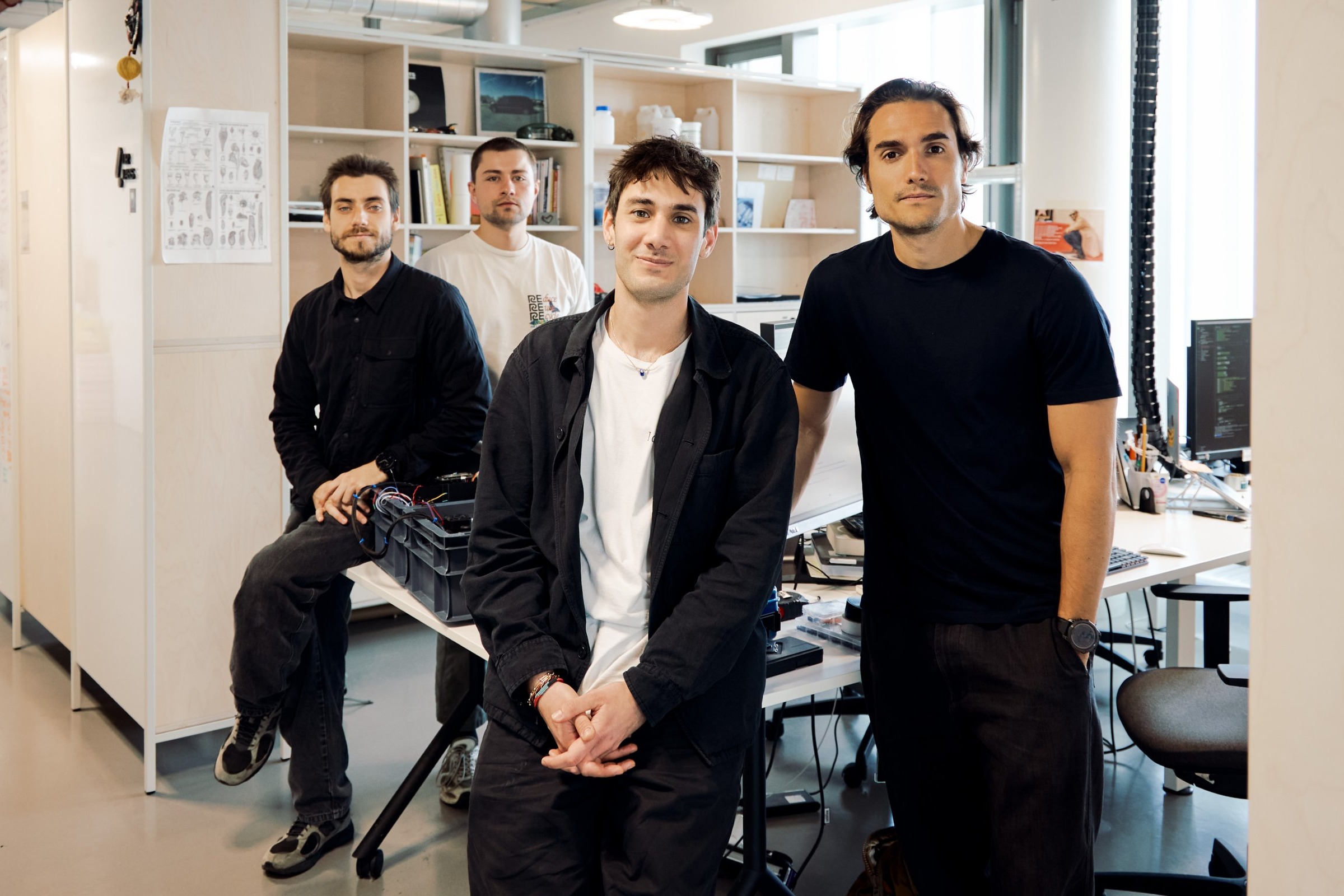
Lir Labs' four founders met on the MSc in Innovation Design Engineering, run jointly by Imperial College London and the Royal College of Art. Together they reached the final eight of the Hult Prize out of 15,000 teams. Between them they cover hardware, data, product and commercial, which is exactly the mix a sensor-plus-software business in a regulated industry needs.
Diego Muñoz (CEO) is an environmental engineer. At Foster + Partners he worked on projects that cut carbon by 35%. Before Lir Labs he co-founded Minttclub and, as COO, helped grow it to $1M ARR. He brings both the engineering fluency to talk to a process engineer and the experience of building a revenue-generating startup.
Benedikt Huber (COO) is an economist and environmental scientist. He was a consultant at EPEA, the circular-economy consultancy founded by Michael Braungart, and Head of Growth at an environmental research lab. He runs Lir Labs' German entity and leads its continental partnerships.
Doruk "Toto" Öztürk (CTO) is a materials engineer who leads the optical hardware development. He previously developed a hydrogen energy module.
Emile Meunier (CPO) is a design engineer with a background in architecture, product design, IoT sensors and EV products. He owns how the product looks and feels to the operator.
Why we invested: customer pull was there from the start
Water is a large, essential and chronically under-digitised market. Energy prices, tighter regulation and the falling cost of computer vision have now converged on the same bottleneck: operators cannot see the biology they are paying to manage. Lir Labs attacks that bottleneck directly, and its imaging data is the foundation for something bigger: autonomous control across the plant, including automated airflow systems, pumps and chemical dosing.
Initially the team was pitching into EU municipal wastewater, UK food and beverage and German biogas at once. We pushed them to narrow down and to prove ROI, and they ran their first real-time microbe imaging on a live municipal plant. Days later, a major German waste and water operator with around 200 plants asked for an LOI.
Through multiple pilots, they now have the first evidence that the sensor catches problems before operators do.
However, water utilities are among the slowest buyers in any sector, with procurement cycles that can run to two years. Lir Labs' answer is to start with private operators and industrial sites, where decisions are faster and the savings land on one P&L. It also leases hardware below tender thresholds, which speeds up the sales cycle.
At Antler, we back exceptional founders from day zero. We're proud to partner with Diego, Benedikt, Toto and Emile as they give the world's water infrastructure the eyes it has always lacked.
ANTLER RESIDENCY —LAUNCH YOUR STARTUP
Antler backs exceptional founders to go further, faster.