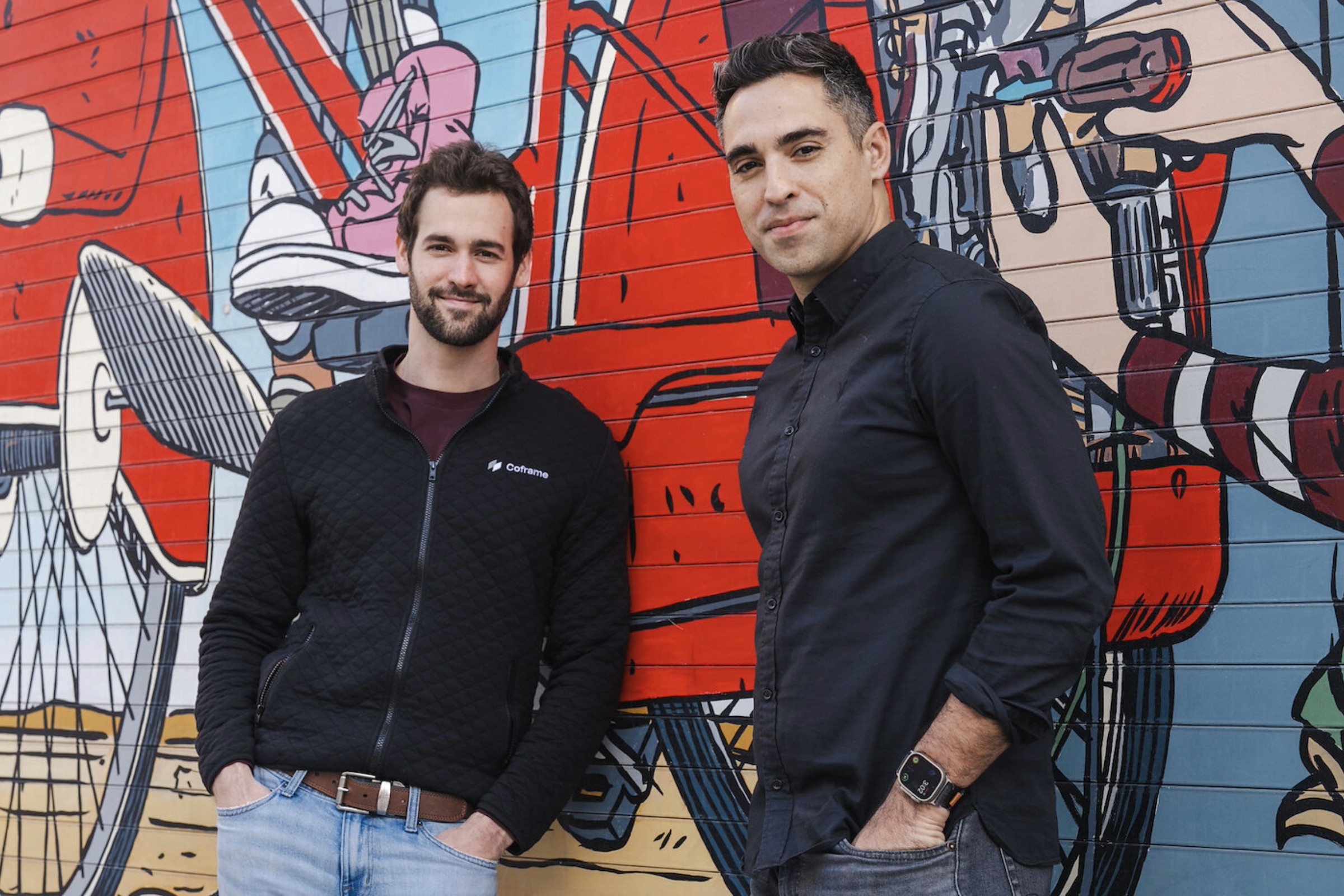


Coframe is building the intelligence layer between every brand and every customer on the internet. Founded by Josh Payne and Pavlo Razumovskyi, Coframe replaces the cross-functional enterprise teams deployed to optimize their digital channels with an AI system that autonomously ideates, designs, builds, tests, and analyzes experience variants.
We were fortunate enough to meet Josh in late 2025, when Coframe was less than a 15-person company selling into the mid-market segment. At the time, our team was thinking holistically about the cause and effect in a “world where humans would be a decimal point of total internet traffic.”
While some may look at Coframe and immediately typecast it as a MarTech 3.0 business, we instead grew enamored with Josh’s views of the future, particularly his view on what the internet will look like in an agent-first world.
As these secular tailwinds continue to proliferate, we're increasingly convinced about Josh’s prediction of the future, and therefore Coframe’s positioning in this new age.
Fast forward to June this year, Cloudflare announced that agentic traffic drove bots to surpass human traffic for the first time in history. Take another step forward to the present day: Muse and Instinct are two of the fastest consumer apps in history, bridging diffusion to the masses for personal consumer agents. Meta Muse reached ~650K daily active users (“DAU”) in its first 12 days, and Instinct has seen user growth of 10-11% a day(!) since launch.
The Problem
Each computing paradigm shift creates a new generation of infrastructure leaders and retires the previous one. The digital experience platform market built by Adobe, Salesforce, and Oracle assumed humans would design the variants, run the experiments, and read the results. That assumption no longer holds.
The category's history is instructive for investors like us. Optimizely defined web experimentation but hit a wall at scale, becoming a bolt-on for CMS to reduce churn. We have seen similar scenarios play out with Dynamic Yield to Mastercard, Statsig to OpenAI, and Eppo to Datadog.
The reason? None of them solved the actual constraint.
The bottleneck was never statistical soundness; it was human throughput, with a designer, an engineer, and an analyst required for every test. Until recently, these programs were extraordinarily expensive, running well over $1M a year, so most companies never ran one.
Enter Coframe
Coframe closes the entire loop autonomously, from idea to deployed variant to measured result. Architecturally, what matters is that Coframe owns the measurement loop. Legacy tools piped experimentation data into customer-owned analytics stacks, so they could never learn across their own customer base.
Personalization is what makes the product impossible to remove and demonstrates something that shows extraordinary stickiness, a foreshadowing difference between a widget and a platform business. If Coframe were turned off, the conversion lift would disappear.
Coframe measures every clickstream tied to every variant it launches, which is the precondition for cross-customer learning. The data feedback becomes far more crystallized in this process - insights travel as model gradients rather than raw data, so even customers with controlled data agreements benefit from the network. Therefore, every customer added makes every other customer's optimization smarter. As a result, Coframe’s first-variant win rate continues to surpass industry baselines by an ever-increasing margin.
The evidence is in what the loop produces. At Replit, Coframe ran experiments across the home, pricing, enterprise, and paid landing pages, lifting enterprise funnel conversion by 410% and doubling demo requests. Replit’s growth team described the difference as having a team of a hundred people. That same loop now runs inside Dropbox, Intuit, and TUI, and across software, financial services, travel, and consumer verticals.
The second act will be even larger and build off the first wave. As we mentioned above, automated traffic has already overtaken human traffic on the web. When a customer's agent arrives having its own context, the page a human would see is the wrong page to serve. The same loop that optimizes interfaces for people applies to agent-native experiences, and the data Coframe accumulates today is exactly what that layer will need.
Results like that change how enterprises buy. Procurement is usually where products like this stall, and Coframe’s cycles are getting shorter rather than longer. The compounding is showing up in commercial operations, with revenue having more than doubled every quarter, and Coframe generating over $150M of incremental revenue for its customers to date. As Josh puts it, the company is “moving away from throwing headcount at the revenue problem.”
The Team
It is hard to imagine a team better matched to this problem. Josh previously co-founded Autograph (prev. raised $200M) and built GPT-Migrate into one of the most-starred projects on GitHub. On top of world-class technical DNA, he also closed the company's first $1M in ARR as its only sales leader.
His co-founder, Pavlo, led Gen AI engineering at Pinterest and scaled an ML-based consumer app past 20 million users.
We’re also excited about the founding GTM team, led by Steve Ebin and Bo Mohazzabi. Steve was the founding head of growth at Optimizely and the founder of Story.com, and Bo Mohazzabi has twice been a top sales producer inside this category at Optimizely and Amplitude.
Why Antler
Antler's platform spans 27 cities across six continents, and our portfolio maps closely onto Coframe's ideal customer profile: consumer, prosumer, and B2B2C businesses whose growth depends on conversion. We're proud to invest alongside co-leads Khosla Ventures and Hanabi Capital, leaders from OpenAI, Anthropic, and Google DeepMind, and existing investors including NFDG, Samsung Next, and Alumni Ventures.
We look forward to partnering with Josh, Pavlo, and the broader Coframe team as they build the intelligence layer between every brand and every customer on the internet, human or agent.

ANTLER RESIDENCY —LAUNCH YOUR STARTUP
Antler backs exceptional founders to go further, faster.