-2.jpg)


Most pitch deck advice tells you what to include. This isn't that.
Yes, I'll tell you what belongs in each slide, but also what's going through an investor's head when they read it. Because those are two very different things, and most founders only ever get told one of them.
We've reviewed hundreds of decks at Antler. We've sat in rooms where investment decisions get made. We've watched founders win and lose in the same ten slides.
A few things before we start
Pre-seed decks are not the same as Seed decks. You have less to prove and more to explain. Investors at this stage are not betting on your traction. They are betting on you, your thinking, and whether the problem you've identified is real enough to build a company around.
Keep it to 10 slides. A founder who can tell a compelling story in 10 slides has already proven something important: they know what matters.
Slide 1: The Problem
What belongs here
One specific problem, felt by one specific person, in one specific moment. Not a market trend. Not a statistic. A problem you can describe so precisely that the person experiencing it would read this slide and think, "That's exactly it."
What the VC is thinking
"Do I believe this problem is real and painful enough that someone would pay to solve it?"
This is the slide where most founders lose investors without realising it. The problem is too broad, too obvious, or too abstract. "Small businesses struggle with cash flow" is not a problem.

"A founder of a 3-person agency doesn't know on Monday whether she can make payroll on Friday" is a problem.

Notice the difference: the strong version names a person, a moment, and a cost. If an investor can picture the exact human on the other side of the problem, you've already earned their attention.
The more specific you are, the more credible you sound. Specificity signals that you've actually talked to customers. Vagueness signals that you haven't.
Slide 2: The Solution
What belongs here
What you've built or are building, explained in plain language. One sentence, if possible. Then a visual if it helps. No jargon, no feature lists, no technical architecture diagrams.
What the VC is thinking
"Is this 10 times better than what exists, or just slightly different?"
Investors are not looking for incremental improvements. They are looking for something that makes the old way feel broken in comparison. If your solution sounds like a feature of an existing product rather than a new category, that's an issue.
They are also checking whether the solution directly addresses the specific problem you just described. You'd be surprised how many decks have a slide 1 and a slide 2 that are answering completely different questions.

The wrong way: buzzwords and a feature list. An investor finishes this slide unsure of what you actually do.

The right way: One plain sentence, tied to the exact person and moment from your problem slide.
Slide 3: The Market
What belongs here
TAM, SAM, SOM. But built from the bottom up, not the top down. Don't tell us the global HR software market is worth $40 billion. Tell me there are 80,000 companies in Australia with 10 to 50 employees, the average spend on your category is $4,000 per year, and your realistic share looks like by year three. When every number traces back to a real customer, the total becomes something an investor can actually believe.

What the VC is thinking
"Is this big enough to matter, and does this founder actually understand their market, or are they just citing a Gartner report?"
Top-down market sizing is one of the fastest ways to lose credibility in a pitch. Every investor has seen "we are targeting a $50 billion market and just need 1% of it". It means nothing. Build it from the customer up, and you immediately stand out.

Slide 4: The Traction
What belongs here
At Pre-seed, traction doesn't have to mean revenue. It means evidence that the problem is real and that people want your solution. Letters of intent, pilot customers, waitlist signups, interviews conducted, prototypes tested. Anything that proves you've been in the market, not just in your head.
What the VC is thinking
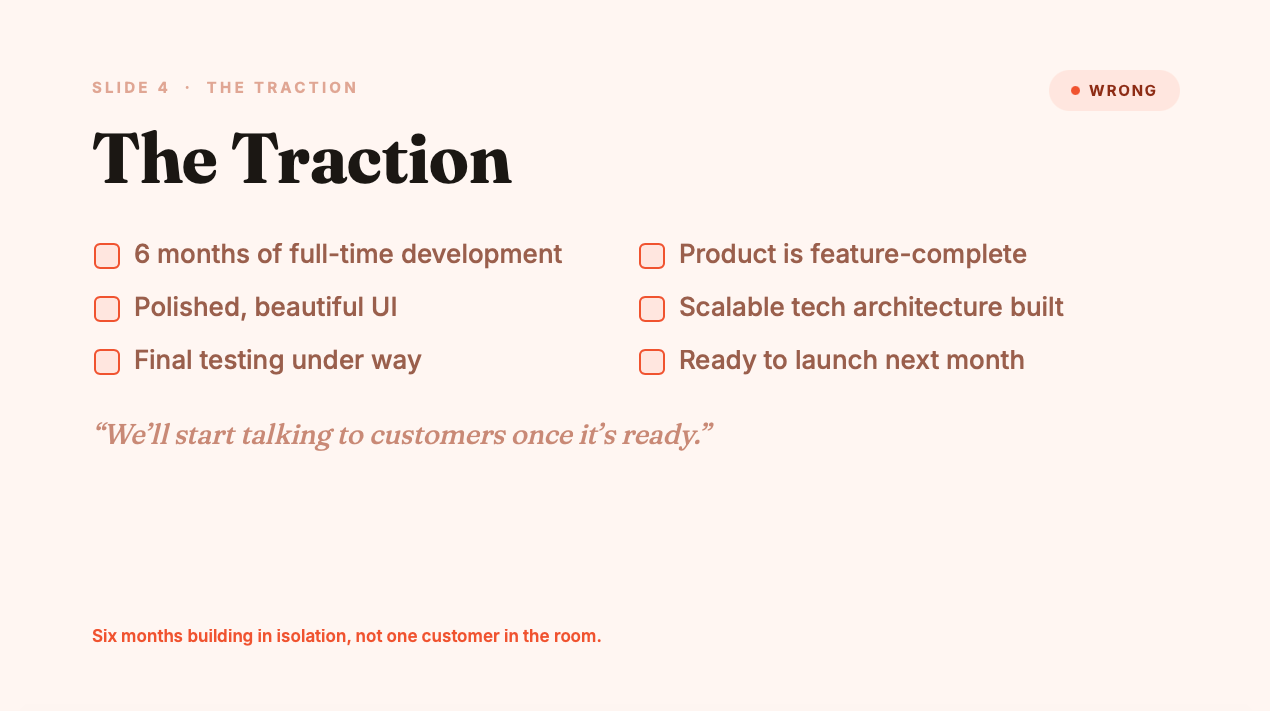
“What proof is there that anyone but the founders wants this?”
The biggest red flag at Pre-seed is a team that has spent six months building without talking to a single potential customer. Conviction isn’t evidence. Investors want to see that you have a bias for action and a willingness to test assumptions before you have a perfect product.
Even ten customer conversations with documented insights is traction. Show the work.

Slide 5: The Business Model
What belongs here
How you make money. Who pays, how much, how often, and why that pricing makes sense for this customer. Keep it simple. If you have multiple revenue streams, pick the primary one and mention the others briefly.

What the VC is thinking
"Do I believe people will actually pay for this, and at a price that makes the business work?"
At Pre-seed this slide doesn't need to be proven. It needs to be believable. Investors want to see that you've thought about pricing in relation to the value you deliver and the customer you're selling to. A founder who says "we'll figure out monetisation later" is a founder who hasn't thought hard enough about their customer.

Slide 6: The Competition
What belongs here
An honest map of the competitive landscape. Not a 2x2 matrix where you've conveniently placed yourself in the top right corner with no one else near you. A real assessment of what exists, why people use it, and specifically where you are different.

What the VC is thinking
"Does this founder know their space, and are they being honest with me?"
Nothing makes an investor more suspicious than a founder who says they have no competition. Every problem worth solving has existing solutions, even if those solutions are spreadsheets and manual workarounds. Acknowledging competition and explaining clearly why you win shows confidence and market awareness.

Slide 7: The Go-To-Market (GTM)
What belongs here
How do you get your first 100 customers? Not your long-term marketing strategy. Not your plan to go viral. The specific, unglamorous actions you will take in the next 90 days to put your product in front of real people.
What the VC is thinking
"Does this founder know how to sell, and do they have a realistic plan to get to their first meaningful milestone?"
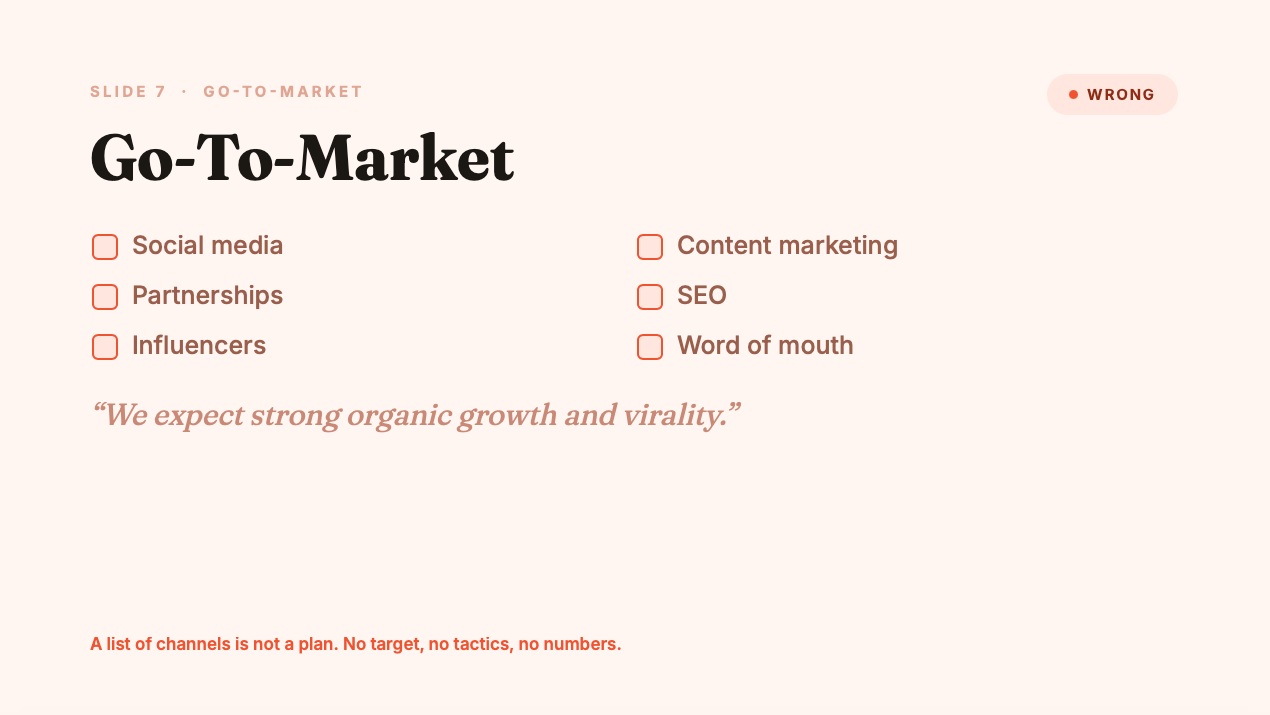
GTM is where a lot of Pre-seed founders get vague. "We'll use social media, content marketing and partnerships" is not a GTM strategy. Name the channels, the tactics, the target customer profile, and the conversion assumption behind each. Show that you've thought about distribution as hard as you've thought about the product.

Slide 8: The Team
What belongs here
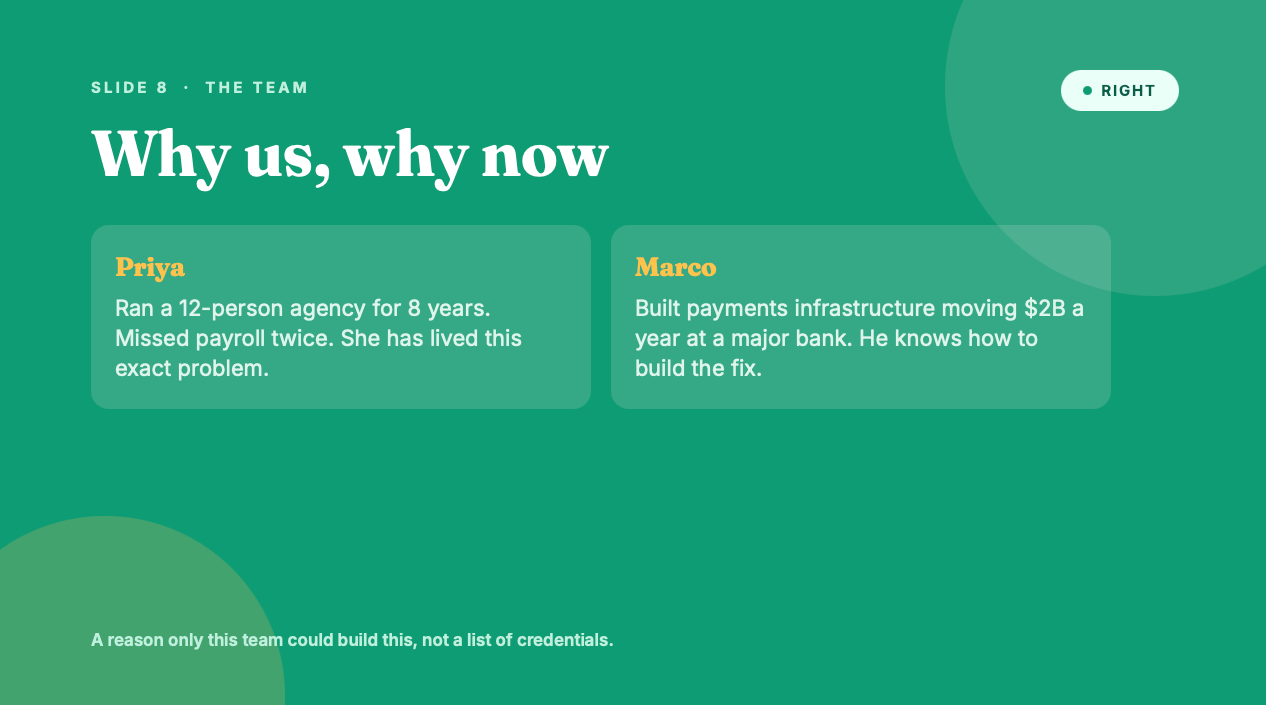
Why you. Why now. Why is this specific combination of people uniquely positioned to solve this problem? Not a list of credentials. A narrative about why this team is the unfair advantage.
What the VC is thinking
"Would I bet on these people if the idea turned out to be wrong?"
At Pre-seed, investors are often backing the team before the idea. They know the idea will change. They want to know that the founders have the resilience, the skills, and the self-awareness to navigate whatever comes next.
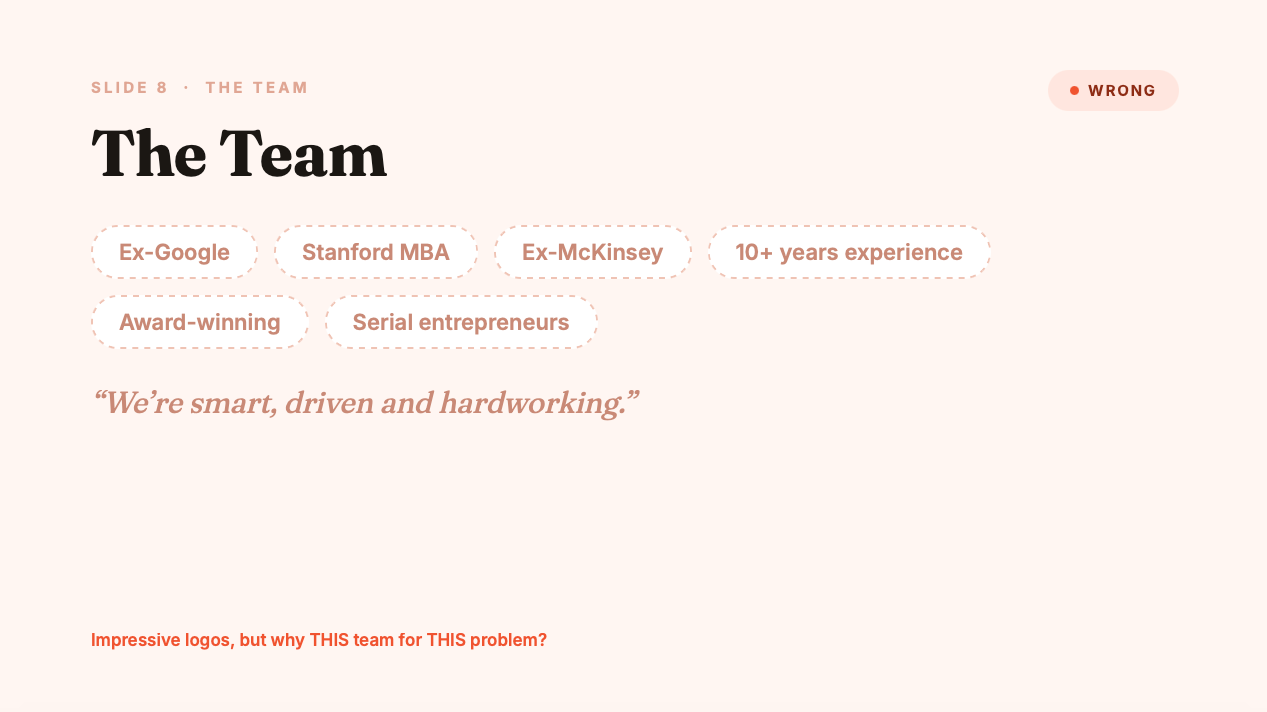
The most powerful thing you can put on this slide is a direct answer to "why are you the right people to solve this specific problem?" If your answer is just "we're smart and hardworking," you haven't answered the question.
Slide 9: The Financials
What belongs here
An 18- to 24-month financial model. Revenue projections, key cost drivers, and the assumptions behind both. At Pre-seed, nobody expects you to be right. They expect you to be thoughtful.

What the VC is thinking
"Does this founder understand the economics of their business, and are their assumptions defensible?"
Investors don't fund financial models. But they use them to test how you think. If your revenue projections go up with no clear explanation of what drives that growth, it tells them you don't understand your own business. Clearly lay out your assumptions and be able to defend each one.

Slide 10: The Ask
What belongs here
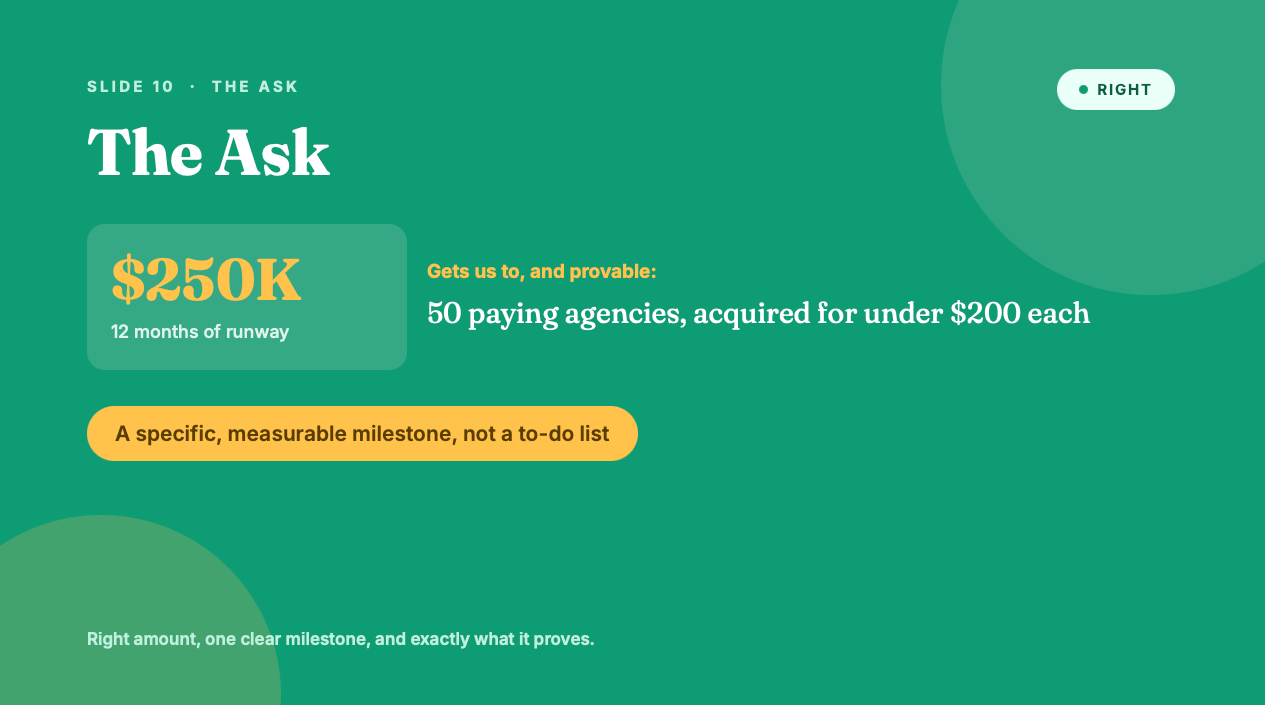
How much you're raising, what you'll use it for, and what milestones that capital gets you to. Be specific about the milestones. "Hire 3 engineers and build the product" is not a milestone. "Reach 50 paying customers and prove we can acquire them for under $200 each" is a milestone.

What the VC is thinking
"Does this amount make sense for what they're trying to prove, and will hitting these milestones make this company fundable at the next stage?"
The ask slide tells investors whether you understand how venture capital works. The capital you raise at Pre-seed should buy you enough runway to de-risk the specific things that are preventing you from raising a Seed round. If your milestones don't clearly do that, you haven't thought hard enough about what the next investor will need to see.
One last thing
The order doesn't matter; your storytelling does, and the deck should be there just to support your story. For example, sometimes I see founders putting the team slide as the first one since the whole idea came together after their first meeting.
Remember, the pitch deck isn’t going to secure investment. It’s the conversation starter. The goal is to make an investor curious enough to want the next meeting.
ANTLER RESIDENCY —LAUNCH YOUR STARTUP
Antler backs exceptional founders to go further, faster.