
.jpg)


Where does AI belong? S&P Dow Jones Indices and MSCI have posed this deceptively difficult question to the investment industry.
On 17 July they opened a consultation on changes to GICS, the classification system that has organised the investable world since 1999. Foundation-model developers are in there. So are AI data-lifecycle businesses and a new generation of application software. The consultation closes at the end of October, and a decision is expected in November.
As GICS has done for more than a quarter of a century, the conventional solution would be to add a category here, and redraw a boundary there. Given the timetable, I suspect this is broadly where they will land. But looking at what is being built much earlier, I wonder if AI presents a different kind of problem, and one unlikely to be settled by November.
GICS is a hierarchy. Every company gets one classification at each level, determined principally by what it does and where it earns its revenue. Whatever else a company may be, the system ultimately has to put it somewhere. Don’t we all love a bit of order?
At Antler we see companies long before anyone at an index provider has reason to think about them. We have invested in close to 2,000 across 26 markets, usually when the company is a couple of founders, an idea and not much else. At that point, categorisation is still pretty unsettled.
AI has gone from part of what we back to most of it, a change you may well find obvious. In 2019, 15% of our new investments had AI as the product itself; by 2025 it was 58%, while non-AI companies travelled almost exactly the other way, from 69% to 17%. The middle came first: AI-enabled, where AI assists an otherwise non-AI business, peaked near a third of our investments in 2020 and held there until AI-core overtook it. What we are seeing now is not companies adding a little AI at the edges, but far more companies for which, without AI, there is no company at all. So, what happens when we stop asking how much AI is involved and instead ask what it is doing?
Among our 575 AI-core companies, the largest group is building autonomous work: agents that take on tasks people used to do. Around them sit the businesses that exist because autonomy creates its own problems. We see trust, giving an agent an identity and permission to act; context, turning messy inputs into something it can use; and coordination, allowing agents to transact and work with other machines (and occasionally humans).
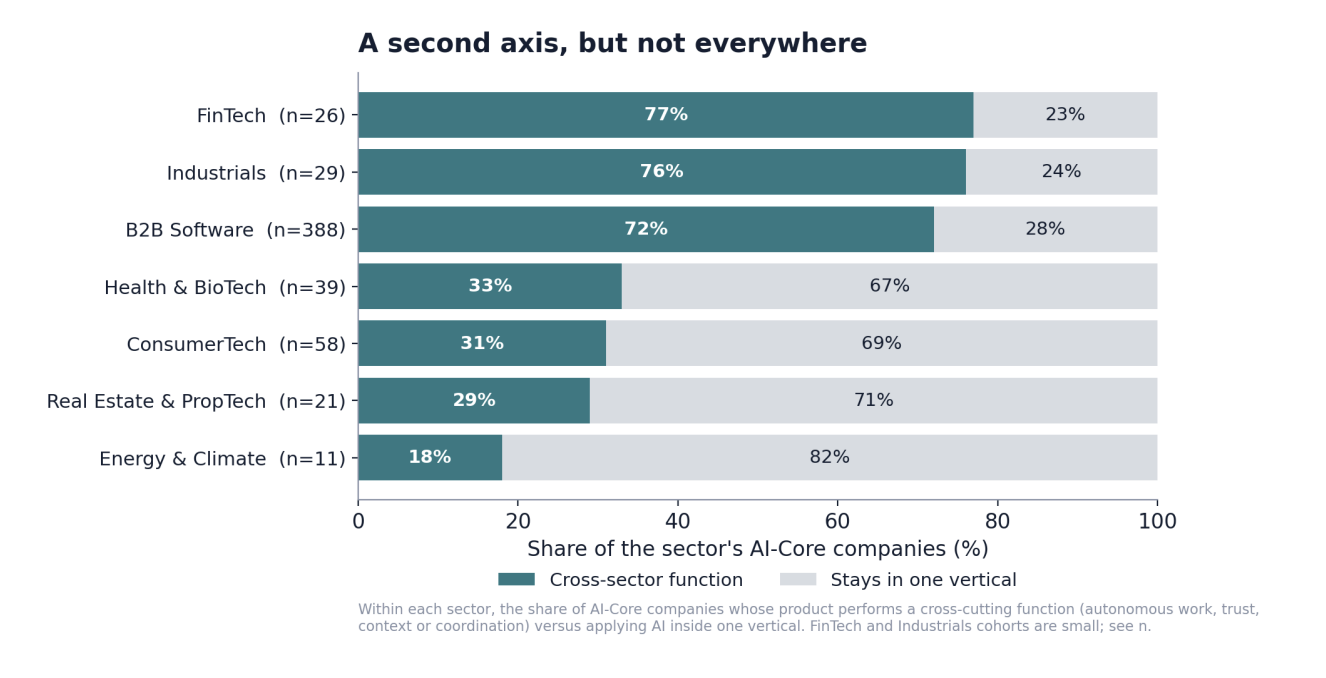
We found 362 companies doing at least one of these jobs. Most are in B2B Software, with industrials and fintech behind them at similar rates. Elsewhere, the picture is more like what you would expect: an AI diagnostic remains recognisably a health company, and much of ConsumerTech, Energy and Property behaves the same way.
GICS can classify those 362 too. Take a company building the rails and guardrails that let autonomous agents move money. It has a principal business activity, and therefore a GICS home. But the classification doesn't capture the fact that payments, security and agent infrastructure have become one product, not three.
Where this happens, AI looks less like a sector than a solvent.
There is an obvious objection. Software has been eating the world for a long time, and cross-industry technology is not news. If all the data showed was AI turning up in insurance, healthcare, manufacturing and restaurants, I would not find it especially interesting. What is new is that the change is happening inside the companies themselves.
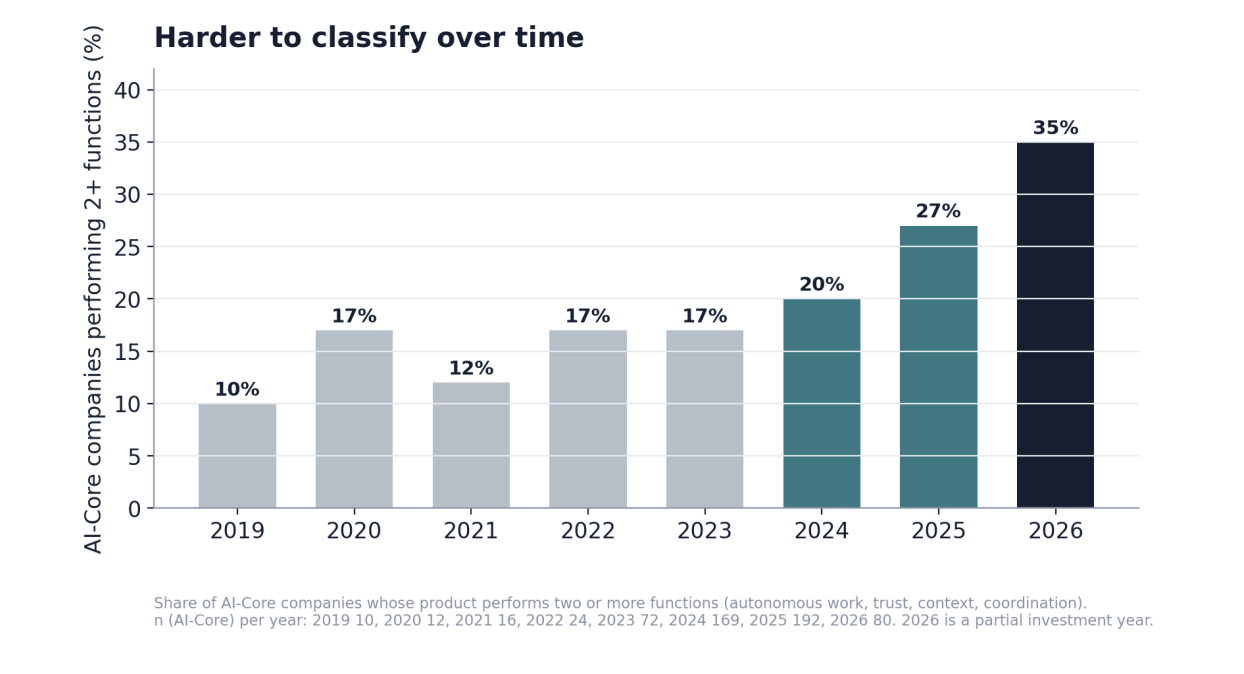
Of those AI-core companies, 133 now combine two or more of these functions. The proportion had gone nowhere in particular through to 2023, bouncing between 10% and 17%, and then it moved: 20% in 2024, 27% in 2025 and 35% of the 2026 vintage so far. GICS can give every one of those companies a principal activity, but not the overlap.
There is a portfolio version of the same thought. Take an insurer, a hospital group and an industrial company. By conventional sector classification, they remain Financials, Health Care and Industrials, exactly as they should. Look instead at technological exposure, and some share of the earnings of all three may rest on the same thing: human information-processing work that autonomous agents can increasingly do.
One map tells you what businesses you own. The other starts to show what technological change they have in common. Traditional sector classifications were never designed to capture that.
There is one last pattern in the data.
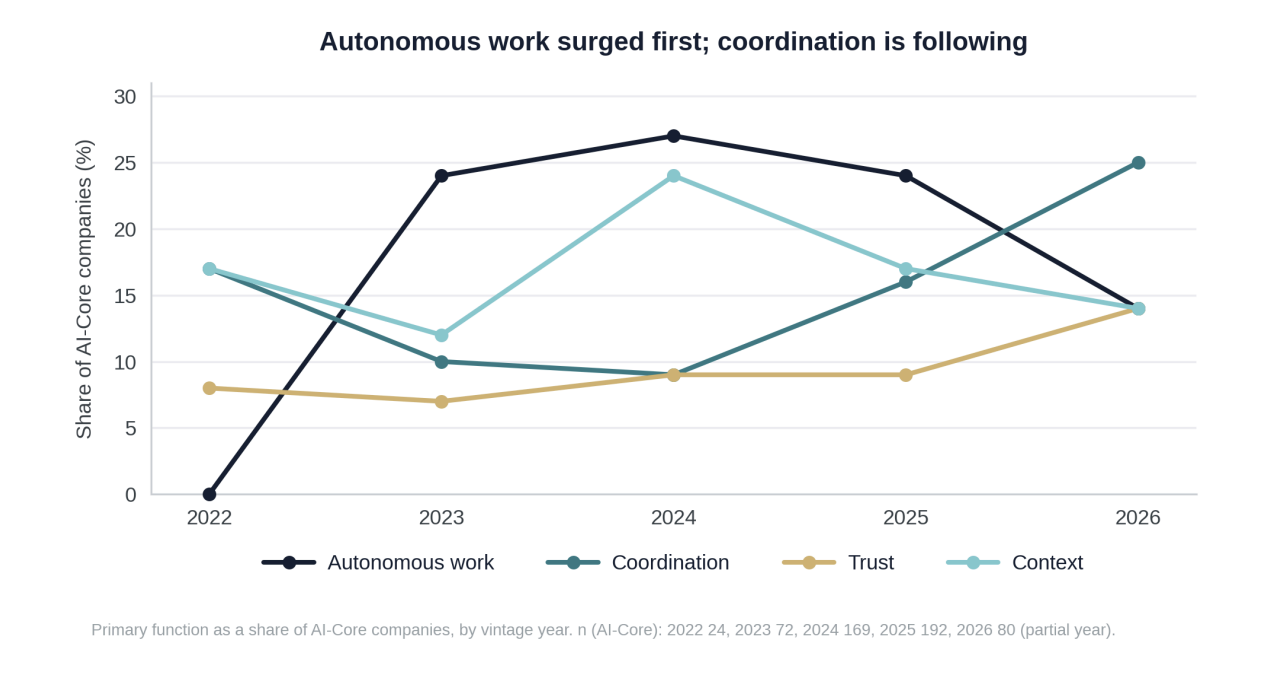
Autonomous work surged first, taking 27% of our AI-core investments in 2024 against coordination's 9%. Two years on, at least so far, the two have almost swapped places: coordination is 25% of the 2026 vintage and autonomous work 14%. For the first time, we are backing more companies whose job is to help agents coordinate than companies whose job is the autonomous work itself.
It is late August as I write this, so I would not make too much of a single unfinished year; but the direction is intriguing.
The agents came first, and now founders are building the machinery they need to operate
S&P and MSCI may conclude that AI needs a few new sub-industries, and they may be right. But looking at what is forming much earlier, I suspect the harder question is not where AI belongs on the existing map, but whether one map alone is still enough.
ABOUT ANTLER INTELLIGENCE
Antler is one of the most active early-stage venture firms globally, with US$1.4B AUM, operations across 26 cities, and a portfolio of nearly 2,000 companies. We invest from pre-seed and seed, where the majority of our portfolio sits, through to Series C via regional early-stage funds and global follow-on vehicles. That structure gives us something few investors have: a longitudinal, cross-geography dataset of founder behaviour and category formation that begins before most institutional investors are in the room.
Antler Intelligence is our research and market insight function for an LP audience. The views expressed here are based on proprietary portfolio data and represent the author's own analytical interpretation of market trends, not an official Antler position on GICS, index methodology, or investment strategy. They do not constitute investment advice, a solicitation, or a representation of fund performance.
DATA AND DISCLOSURE
Internal portfolio data reflects Antler's dataset as of August 2026, covering close to 2,000 companies across all statuses (active, written off, exited).
AI depth uses a four-tier classification applied consistently since 2019: Infrastructure/Deep Tech AI and AI Dev Tools; Application Layer AI; AI-enabled, where AI assists part of an otherwise non-AI business; and Non-AI, where AI is not material to the product. AI-Core denotes the first two tiers, where AI is the product itself. Adoption figures reflect investment decisions by year and exclude companies with no recorded investment date or incomplete classification.
Functional classification (autonomous work; trust, being identity, permission and verification; context, the turning of unstructured data into machine-usable form; coordination; or vertical-only) was performed by analysing each AI-Core company's website, pitch deck and product description against defined criteria. A company may carry one primary and one or more secondary functions, and "two or more functions" counts primary plus secondary. Classification is analytical judgement, not a mechanical count, and a full company-level listing underlies every figure. Functional layers concentrate in B2B Software and FinTech; elsewhere AI is more often applied within a single vertical.
Vintage counts reflect AI-Core companies with a completed functional classification; companies without a usable product description are excluded, and a share of 2026 companies not yet tagged in our system were classified manually from descriptions. Counts will therefore not tie exactly to a system export. Vintage counts (AI-Core): 2022 n=24, 2023 n=72, 2024 n=169, 2025 n=192, 2026 n=80. Cohorts before 2023 are small, so earlier shares are indicative rather than precise. 2026 figures are provisional and reflect a partial investment year.
External sources: S&P Dow Jones Indices and MSCI, consultation on potential changes to GICS, 17 July 2026 (consultation closes 30 October 2026); MSCI GICS methodology.

ANTLER RESIDENCY —LAUNCH YOUR STARTUP
Antler backs exceptional founders to go further, faster.

%20(1).jpg)
%20(1).jpg)
