


The world of Match-Making today sits on a spectrum. At one end are self-serve binary swipe apps - infinite choice, zero depth, and business models built on engagement, not outcomes. At the other are human matchmakers - expensive, high-touch, and effective, but accessible to only a few. Between them there is a fast-growing middle: curated dating apps.
To illustrate this evolution, we mapped the global matchmaking landscape across two broad categories - Self-Serve and Curated/Personalised, with a hint of AI-Native.
.avif)
The “curated middle” is where most of the innovation has happened in the last five years. Some apps build trust through verification (Juleo). Others make women the gatekeepers (Elevn). A few go culture-first (like Vinita or Dil Mil), while others take a personality-led approach (like Boo or Hinge). Each tries to solve a piece of the puzzle but none have solved the entire puzzle yet.
We believe that AI could collapse this spectrum, bringing the intimacy of a $100,000 matchmaker to millions at a fraction of the cost. In this piece, we go deeper into the state of the matchmaking market today, a few reasons why it needs innovation, and why we believe India one of the few markets structurally wired for success here.
State of the (un)Union
Dating apps put the onus on users to find the right partner from what the algorithm serves. The result is growing fatigue. The global dating market, once considered unstoppable, is now showing clear signs of saturation. The stock prices of Bumble and Match Group, which together operate over 45 dating products including Tinder, Hinge, and OkCupid, have fallen nearly 90% and 68% in the past five years, erasing more than $40 billion in market value since 2021. Most notably, giants have also scaled back in India (reducing team sizes by 50%) owing to user dissatisfaction, highlighting a massive whitespace to build in the region.
There is also a growing, grave need for intentional curation. The darker sides of dating online are less talked about. Seven out of 10 online daters confirm they encounter people lying on their profiles, and 66% of women ages 18 to 49 reported being harassed. Another 56% said they were sent sexually explicit images they didn’t ask for. After, a female-founded dating app tries to tackle ghosting and holding people accountable, but is still early.
This growing disillusionment is creating room for something new. The future of matchmaking will belong to products that truly deliver on personalisation, at scale.
A Few Well-Intentioned Attempts At Fixing Online Dating
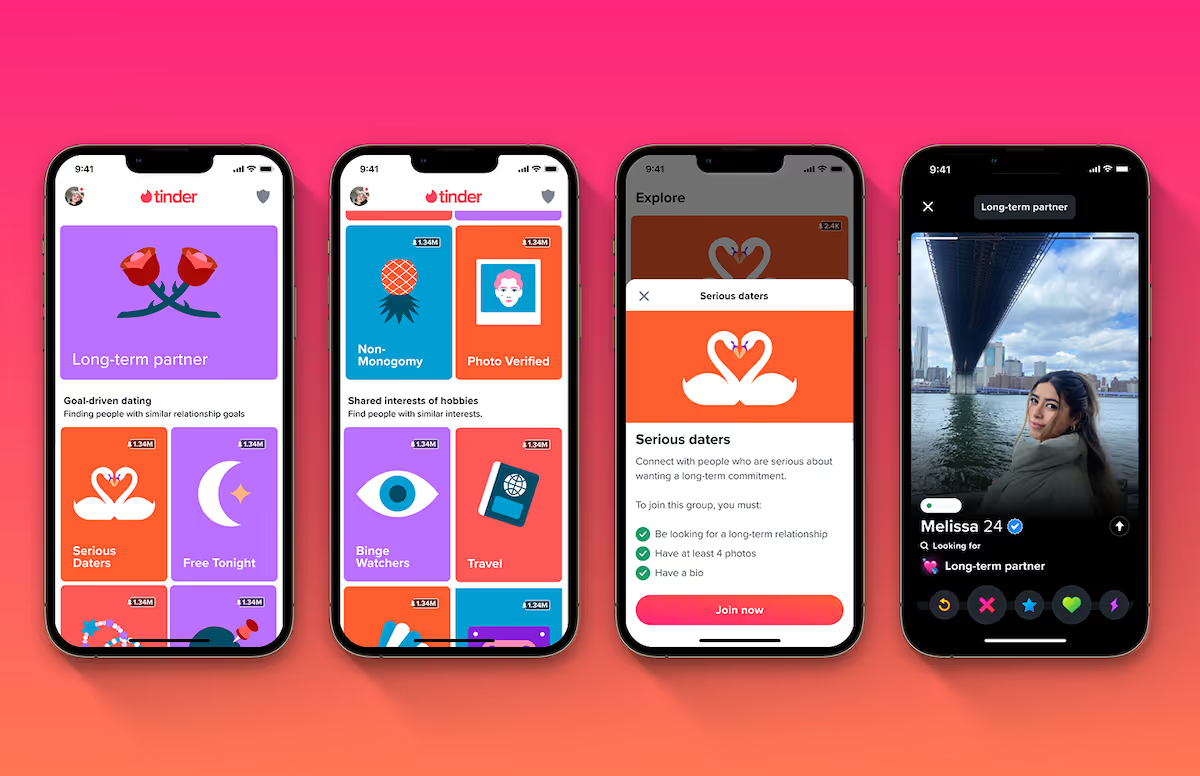
Many platforms have tried to bridge the gap through stronger curation. Earlier this year, Tinder revamped its “Explore Page” to let users choose from intent-based categories - Non-Monogamy, Serious Dater, Short-Term Fun, Long-Term Partner, and New Friends - helping people connect with aligned intentions.
In India, a new wave of curated apps has emerged. Juleo verifies users via government ID. Verona background-checks “high-accomplishing” individuals. Elevn, co-founded by Karan Johar, puts women at the center (men can’t engage unless approved), ensuring a safer, more curated experience. It also uses AI-driven profile creation and compatibility scoring, pairing that with exclusive offline events across major cities. Aisle launched Jalebi and a suite of language-first apps for culture-filtered matchmaking.
Globally, similar experiments are taking shape. Happn pioneered location-based matching; Raya became the “dating app for celebrities”; Vinita and Dil Mil serve the South Asian diaspora; Boo builds around personality types; and Thursday focuses on real-world meetups. These products have nudged the ecosystem forward but most still operate on the same engagement rails. They solve for optics and safety, not for the deeper emotional or psychological fit users crave.
As fatigue with swiping grows, new offline formats are re-emerging. Speed dating, mixers, and personal ads are back, while running clubs have become the latest venues for connection. Together, they reflect a single truth: people are ready to move beyond algorithms that optimise for attention and toward systems that optimise for outcomes.
Enter AI-Native Matchmaking
A new category of apps is now emerging. Here, you don’t swipe, you converse / talk to an intelligent agent that learns your preferences, filters, and constraints, and does the work: finding, vetting, and setting up introductions that reflect who you are, not just what you select.
In our view, this is a market-expansion technology in what is today a ~$10B revenue pool. Traditional dating apps succeed 9–11% of the time; professional matchmaking achieves 70–80% success. AI can bridge that gap, delivering the intimacy of a $100,000 concierge service at massive scale.
India is a Primed Ground
In India, however, this is still day zero and we believe it's uniquely positioned for success:
- It’s one of the few categories where users already pay for outcomes, not engagement. Matchmaking has always been a trusted, paid service: a modern extension of an old cultural norm. Despite being listing-first only, Matrimony.com (the parent company of Bharat Matrimony and a few others) is at an annual revenue of INR 500 Cr (March 2025).
- India’s relationship economy is trust- and intent-led, not casual. With one of the lowest divorce rates (0.01 divorces per 1,000 people) globally, low female workforce participation, and fewer organic meeting spaces, digital matchmaking fills a structural gap, not just a social one.
- This is also one of the few categories that defies India’s low ARPU story. Trust, privacy, and relevance are premium currencies here and personalisation drives willingness to pay.
We’re excited about founders from India reimagining this space. By combining customer obsession and psychological depth, there is an opportunity to create a product that feels truly personalised at scale. Done right, this extends far beyond dating; it is an opportunity to reimagine how humans form and sustain relationships.
ANTLER RESIDENCY —LAUNCH YOUR STARTUP
Antler backs exceptional founders to go further, faster.

.jpg)
