


Most compliance software is built for rules that have existed for decades. ReFresh was built for a rule that, until recently, barely existed at all.
In 2025, psychosocial hazards became formally regulated across every Australian jurisdiction, requiring employers to identify, assess, control, and manage psychological health risks with the same rigour applied to physical safety. For the first time, intention was not enough. Organisations needed documented systems, auditable evidence, and board-level governance, or they risked enforcement.
Harrison Kennedy, co-founder of ReFresh, had been watching the gap between regulatory expectation and operational reality widen for years. When the law finally moved, he was ready. He had spent years understanding exactly why the existing tools were never going to be enough.
Spotting the Gap Before the Market Did
Harrison's path to ReFresh started in workplaces, years spent in and around the mental health space, including co-creating a podcast called Really Mental that ran for 79 episodes and was picked up by Amazon.
"The throughline across all of that was a pattern I kept seeing", he says. "Organisations would invest in supporting individuals after harm had already occurred, but rarely addressed the structural conditions creating that harm in the first place. EAPs, resilience training, and wellbeing apps. All downstream. None of it changed the system."
The regulatory shift was the catalyst. When all Australian States began mandating psychosocial hazard management under Work Health and Safety law, Harrison saw the infrastructure gap immediately. Physical safety had decades of purpose-built systems. Psychosocial safety had surveys, spreadsheets, and good intentions.
The data confirmed the scale of the problem. According to Safe Work Australia's most recent analysis, the median compensation paid for mental health conditions has reached $67,400 per serious claim — more than four times the $16,300 median across all other injuries and diseases. The time lost tells an equally stark story: workers with mental health conditions are absent for a median of 35.7 working weeks, almost five times the 7.4-week median for all other serious claims. These are a systemic failure with a measurable and growing price tag.
"The gap between what the law now required and what organisations could operationally deliver was massive", Harrison says. "And no one was building the system to close it. That's where ReFresh started."
Building a Category From Scratch
When ReFresh launched, the term "psychosocial compliance platform" wasn't one that buyers were searching for. The market was fragmented: broad WHS platforms that treated psychosocial risk as one module among sixty; engagement survey tools that measured sentiment but not hazards; consultants producing one-off reports that sat in drawers.
None of those were compliance systems. And Harrison knew it.
"Building the category means you're not just selling a product," he says. "You're educating the market on why the category needs to exist in the first place. Every conversation starts with the obligation reveal, helping people understand what the regulation actually requires, then showing that nothing they currently have meets that standard."
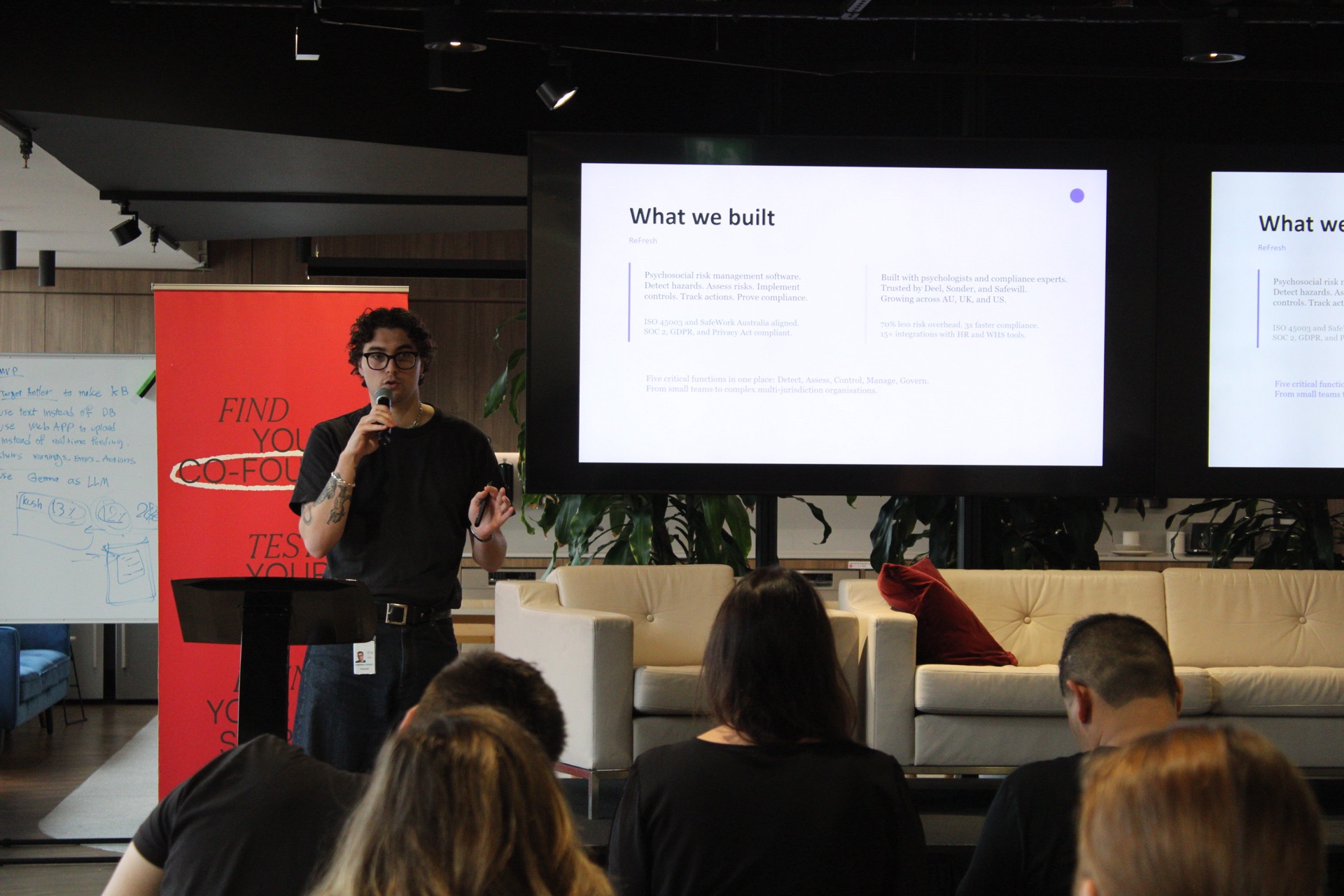
The platform Harrison and co-founder Taylor Laing built is structured around psychosocial risk as an ongoing compliance function. It includes formal risk registers aligned to all 17 psychosocial hazard categories, control and evidence tracking, consultation records, audit workflows, and governance dashboards, all versioned and auditable to support board-level reporting and regulator review.
The regulatory landscape has made this not just desirable but legally necessary. By 1 December 2025, the Occupational Health and Safety (Psychological Health) Regulations came into effect in Victoria, completing a national shift where every Australian jurisdiction now requires employers to explicitly identify, assess, and control psychosocial hazards. NSW introduced the Work Health and Safety Regulation 2025, consolidating psychosocial risk duties into a clearer enforcement framework. Inspector visits relating to psychosocial risks were expected to increase by 25%, with organisations employing 200 or more workers flagged for proactive compliance checks.
Winning Enterprise Trust Before the Market Caught Up
Selling into enterprise as an early-stage startup is hard in any category. In a category that most buyers don't yet know exists, it requires a different kind of discipline.
"The biggest challenge was that most organisations didn't know the obligation existed, or believed they were already covered by their existing programmes," Harrison says. "A People and Culture leader who has invested years in an EAP and a Culture Amp subscription genuinely believes they're doing the right thing. And they are, for employee experience. But the regulation asks a different question: can you identify the 17 specific hazard categories, prove you've assessed them, show what controls you've put in place, and demonstrate ongoing monitoring? That's a compliance lifecycle, not a survey."
Harrison's response was to invest heavily in regulatory specificity, building the credibility to speak precisely to jurisdiction-by-jurisdiction requirements, enforcement trends, and claims data. Every first conversation was framed around the compliance gap, not the product.
"Enterprise doesn't buy products, it buys certainty", he says. "Your platform can be technically superior, but if the buyer can't see how it fits into their existing governance structure, who owns it internally, and how they'd explain it to their board, the deal stalls."
The approach worked. Within five months of founding, ReFresh secured a partnership with Deel, the global payroll and HR platform valued at $17.3 billion USD, alongside employee assistance provider Sonder. The platform is now in use at Safewill, Amped HQ, and Nakatomi, and has achieved SOC 2 Type II, GDPR, and CCPA compliance in just seven months.
A Global Shift, Not Just an Australian One
Australia is not alone. Governments across the world are waking up to the same reality. The UK, Canada, and New Zealand have all moved to make psychological safety a legal obligatio. An internationally recognised framework, ISO 45003, now gives organisations a global standard to work toward. The regulatory direction is clear, and it is not reversing. What Australia is experiencing today, every major economy will be navigating within the decade.
ReFresh is already operating in the UK and Canada alongside Australia. The regulatory wave Harrison anticipated in 2024 is becoming a global tide, and the company is positioned ahead of it. "Psychosocial safety is no longer a soft issue", Harrison says. "It is a governance issue, and the expectations of organisations have changed permanently"
Operating With Leverage: AI Agents and Thousands of Commits
ReFresh has structured itself to move at a pace that would typically require a much larger organisation. With a small team supported by AI agents and thousands of code commits already deployed, the operational infrastructure was built in from the start.
"The operational cost of not having systems early is something most founders underestimate," Harrison says. "If we'd tried to scale headcount first and build systems later, we'd have burned through runway without the output to show for it."
Why Antler Backed ReFresh Before the Market Existed
For Antler Partner Michael Kron, the decision to back Harrison came down to something harder to quantify than a market thesis.
"Harrison was high energy, purpose driven, and could context switch with almost zero cognitive cost," Kron says. It's a profile Kron has seen in category-defining founders before: “The ability to hold the long-term vision and the immediate operational detail simultaneously, without losing grip on either.”
When asked what separates founders who successfully build new categories from those who don't, Kron's answer is precise: "Ability to bend the world and influential people to their will and mission, high degree of adaptability, and deeply focused on a niche starting point."
ReFresh demonstrates all three. The niche is psychosocial compliance, specific, defensible, and now legally mandated. The adaptability is in how Harrison moved from conviction to company through the Antler residency, finding co-founder Taylor Laing and pressure-testing the thesis before a single line of code was written. The mission-bending is visible in the enterprise partnerships, the regulatory credibility, and the speed at which a pre-seed company has positioned itself as the default infrastructure for a category it helped define.
Antler's initial investment enabled the company to start building before revenue existed. When ReFresh raised its $1.3 million pre-seed round, led by Black Nova VC with participation from Archangel Ventures and Antler, the Antler network was instrumental in those introductions. "Beyond capital, the value has been in the founder community, networks, and the operational support during the messiest early months", Harrison says.
The Lesson for Founders Building in Emerging Categories
If there is a single thread running through ReFresh's early story, it is this: content is as much a product as software when you are creating a category.
"We publish regulatory analysis, compliance guides, and thought leadership not because it's a marketing tactic, but because it's how we establish that the category is real and that we understand it better than anyone," Harrison says. "Every blog post, every compliance brief, every piece of content is an argument for why this category needs to exist."
His advice to founders building in new or emerging categories is direct: “Don't soften the message to make people comfortable. The obligation is real. The enforcement is accelerating. The gap between what organisations have and what regulators expect is significant. State that plainly.”
Michael Kron's closing advice echoes that conviction: “Work with investors who believe in you, who are aligned with your vision, and who will stay the course”. In a category that didn't exist 18 months ago, that alignment, between founder, mission, and backer, may be the most durable competitive advantage of all.

ANTLER RESIDENCY —LAUNCH YOUR STARTUP
Antler backs exceptional founders to go further, faster.

-2.jpg)
