.jpg)


In early 2024, Sam Altman told Reddit co-founder Alexis Ohanian that he and his CEO peers maintained a betting pool for the year the first one-person billion-dollar company would emerge. He called it “something that would have been unimaginable without AI and now will happen.” Later that year, Dario Amodei was asked on stage when the first billion-dollar company with a single human employee would appear. His answer was “2026,” with 70 to 80 percent confidence.
Both, it seems, were roughly right.
Whether the company most often cited fully qualifies is almost beside the point. What matters is that two of the more credible forecasters in technology made a specific, time-stamped prediction about the economics of company building. The evidence is beginning to move in their direction.
What the early-stage data was showing before any of this became a mainstream conversation is where this piece begins.
What we assumed
For most of Antler’s history, the received wisdom on solo founders was consistent with the broader venture consensus: teams survive longer, raise more easily, and build more resilient companies. The logic held up to scrutiny. Founding is cognitively uneven work. Two people divide pressure, challenge decisions, and compensate for each other's blind spots. A single founder who hits a wall has no one to hand the problem to.
Our early data supported this. Among companies we backed between 2019 and 2020, solo founders were written off at roughly three times the rate of founding duos: 49 percent against 16 percent across those two vintages. The gap was wide enough to be operational rather than statistical noise, and it shaped how we thought about team formation during residency programmes.
The gap has nearly closed. Understanding why is more complicated.
What the data shows
Across 1,747 portfolio companies with complete founding team records, spanning 2019 to 2026, 539 were built by a single founder (31 percent of the dataset). Three findings stand out.
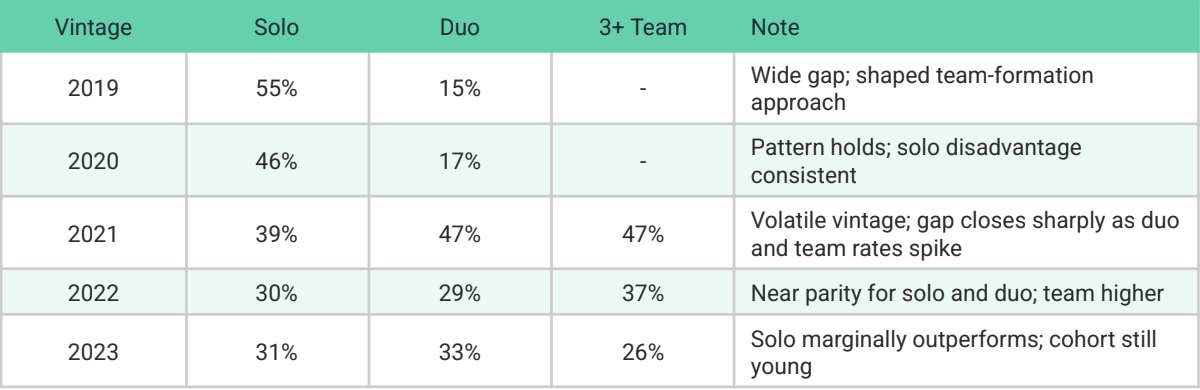
The first is the convergence itself. By the 2022 and 2023 investment vintages, write-off rates for solo founders and founding duos had reached parity: 30 percent against 29 percent in 2022, and 31 percent against 33 percent in 2023, where solo founders were marginally more likely to survive. Whether that last figure reflects a real shift or the relative youth of those companies is an open question; the 2023 cohort is only two to three years old, which is not long enough to be conclusive. Four consecutive vintages now point in the same direction:
Write-off rates by founding team size and vintage
The second finding matters more. Within the solo founder cohort, AI companies behave differently from non-AI companies. Across AI-classified companies in the mature vintages, solo founders fail at 33 percent, founding duos at 28 percent, and teams of three or more at 28 percent: a five-point spread. Among non-AI companies, the equivalent figures are 40 percent, 36 percent, and 34 percent.
The absolute level matters more than the spread. AI classification appears to reduce failure rates more than adding a co-founder does.
Over the same period, the disadvantages associated with solo founding and AI companies both appear to have weakened.
The third finding inverts the assumption. Among companies that survived beyond the write-off stage, solo founders raised external venture capital post-Antler at a higher rate than founding duos or larger teams: 31 percent of surviving solo founders raised outside capital, against 24 percent of duos and 23 percent of teams. This may reflect stronger operator quality surviving a harder early filter, or a broader shift in how investors assess founder risk. The pattern holds across geographies and sector classifications, which makes it harder to attribute to a single regional dynamic.
Interpreting the signal
Four caveats here.
Selection quality is the hardest to rule out. Antler’s investment committee has made hundreds of decisions on solo founders over six years. If the IC has simply improved at identifying which solo founders are worth backing, the observed improvement in survival rates reflects better judgment, not changed economics. The data cannot distinguish between these explanations.
The 2023 and later vintages are too young for the write-off analysis to be fully reliable. Companies fail on longer time horizons than two or three years; the 2019 cohort reached its peak write-off rate around the four-to-five-year mark. Some of what looks like convergence in recent cohorts may be failure that has not yet occurred.
The AI classification itself has inflated over time. In 2024 and 2025, a significant proportion of companies described themselves as AI in one form or another. Some of the gaps may reflect labelling rather than underlying resilience.
Solo founders represented 53 percent of Antler cohorts in 2019 and 48 percent in 2020. By 2023 that figure was 26 percent, and by 2025 it was 20 percent. The pool of solo founders in our data has halved as a share of the portfolio over the period this analysis covers. Whether the observed improvement in solo founder outcomes reflects changing economics, a smaller and more selected pool, or some combination of the two, is a question the data cannot fully answer.
These limitations do not invalidate the pattern, but they do suggest the results should be treated as an emerging signal rather than a settled conclusion.
The early-stage view
What the data cannot resolve, it can at least frame. Across our 2024 to 2026 cohorts, 126 solo founders are building companies classified under one of our three AI categories. Seventy-six of those are building core AI: application layer, infrastructure, or developer tools, not companies that have simply adopted AI as a feature. Those founders will provide the next test of whether the pattern holds.
Traditional venture frameworks still assume founder count is tied to company durability. The data suggests that assumption has weakened over the same period that AI tooling has become accessible to individual operators. Whether that weakening is causal, and whether it is permanent, are questions that will take another three to five years of portfolio data to answer properly.
Antler has backed solo founders since our first cohort. How we think about team formation has evolved alongside the data, and we expect that to continue. What appears increasingly less certain is that a founding team of two is inherently more durable than a founding team of one. For an asset class that prices company potential at inception, that is not a trivial observation.
ABOUT ANTLER INTELLIGENCE
Antler is one of the most active early-stage venture firms globally, with US$1.3B+ AUM, operations across 26 cities, and a portfolio of nearly 2,000 companies spanning every major technology market. Antler Intelligence is our research and market insight function designed for an LP audience. The views expressed here are based on proprietary portfolio data and represent our analytical perspective on market trends. They do not constitute investment advice.
DATA AND DISCLOSURE
Analysis is based on Antler's internal portfolio dataset as of May 2026, comprising 1,747 companies with complete founding team records, spanning 2019 to 2026 across 24 countries. Founder count is derived from fields in Antler’s internal dataset, recording each named co-founder at the time of investment; validated against Hub portfolio records on a sample basis. Survival analysis uses 2019 to 2023 vintages as the primary base to allow sufficient time for write-off rates to stabilize; 2024 to 2026 cohorts are referenced for formation-stage observations only. AI classification uses Antler’s four-tier internal taxonomy (Infrastructure/Deep Tech AI, Application Layer AI, AI Dev Tools, AI Enabled), applied at investment based on company description and Antler’s analytical judgment. Selection quality improvement in Antler’s investment process cannot be ruled out as a contributor to observed changes in solo founder survival rates.
ANTLER RESIDENCY —LAUNCH YOUR STARTUP
Antler backs exceptional founders to go further, faster.

%20(1).jpg)